
What Is an Ad Exchange? How It Works for Publishers
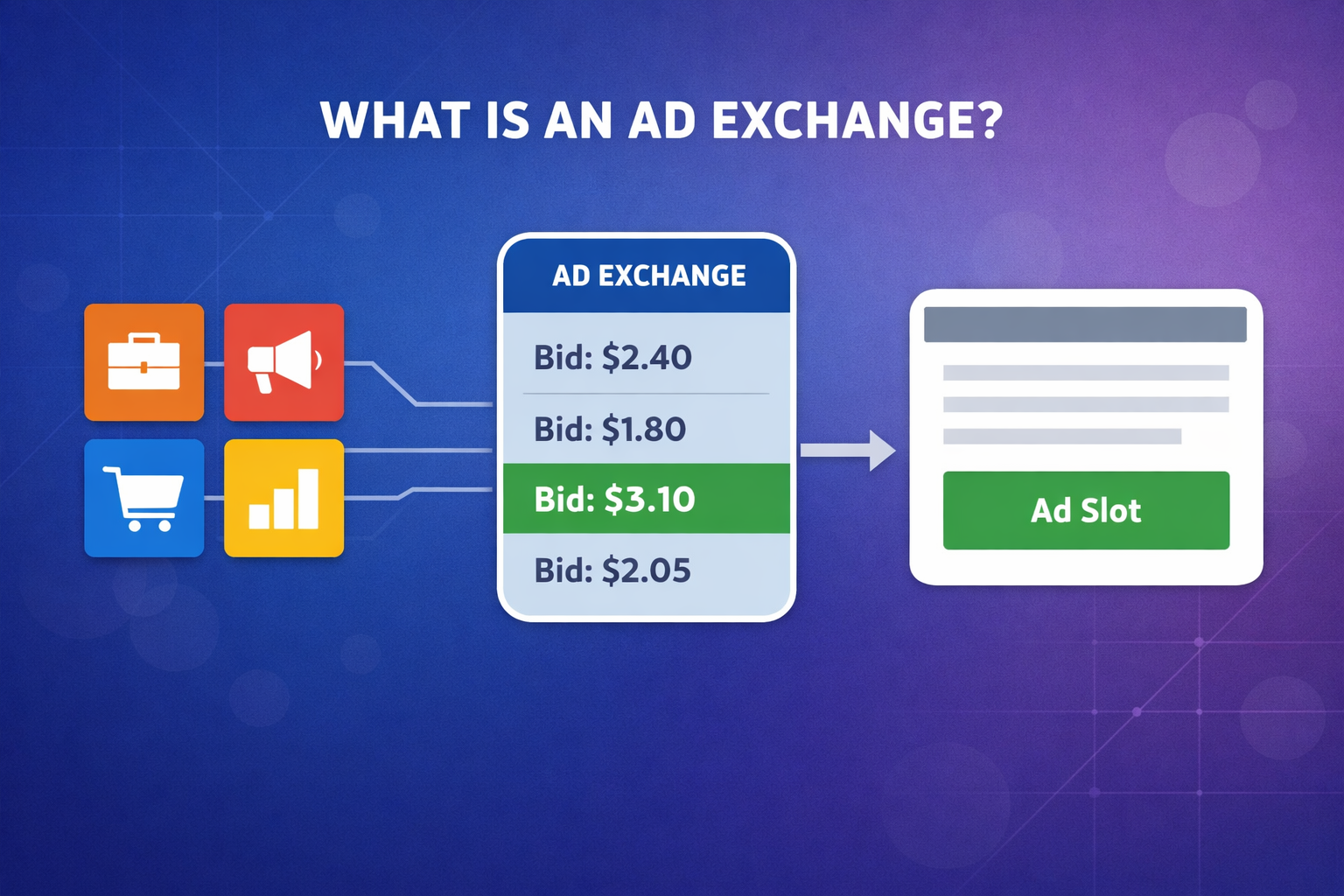
Every time a user loads a webpage, a complex auction takes place behind the scenes. In the fraction of a second between the page request and the ad appearing on screen, dozens of advertisers compete to show their ad to that specific user. The technology that makes this possible is the ad exchange.
For publishers, understanding how ad exchanges work is essential because they directly determine how much you earn from your ad inventory. This guide explains what an ad exchange is, how the auction process works, what makes ad exchanges different from ad networks, and how publishers can access premium exchanges like Google AdX.
What Is an Ad Exchange?
An ad exchange is a digital marketplace where publishers sell ad inventory and advertisers buy it, with each transaction happening through an automated, real-time auction. Think of it as a stock exchange, but for advertising: instead of trading shares, buyers and sellers trade ad impressions.
Before ad exchanges existed, publishers sold their ad space through direct deals with advertisers or through ad networks that acted as intermediaries. This process was slow, opaque, and left significant revenue on the table. Ad exchanges changed this by introducing real-time bidding (RTB) – a system where every single ad impression is auctioned off individually, in real time, to the highest bidder.
The result is a more efficient market. Publishers get the highest possible price for each impression because multiple buyers compete simultaneously. Advertisers get better targeting because they can evaluate each impression individually and bid based on the value of that specific user.
Key Components: RTB, SSPs, and DSPs
An ad exchange does not operate in isolation. It is part of a larger ecosystem of technologies that connect publishers with advertisers. Three components are essential to understand.
Real-Time Bidding (RTB)
RTB is the auction mechanism that powers ad exchanges. When a user visits a webpage, the available ad slot is put up for auction. Advertisers submit bids in real time, and the highest bid wins the impression. The entire process – from the page request to the winning ad being displayed – takes roughly 300-1000 milliseconds.
Supply-Side Platforms (SSPs)
An SSP is the technology that publishers use to connect their inventory to ad exchanges. The SSP sends bid requests to the exchange on behalf of the publisher, applies price floors (minimum bid thresholds), and manages which buyers are allowed to bid. Major SSPs include Magnite, PubMatic, and Index Exchange.
In practice, the line between SSPs and ad exchanges has blurred significantly. Many modern SSPs – such as Magnite, OpenX, and PubMatic – operate their own exchanges, meaning they both connect publishers to external demand and run auctions themselves. When you see these companies listed as “ad exchanges,” they are typically functioning in both roles simultaneously. For publishers, this distinction matters less than the outcome: what matters is that your inventory reaches the widest possible pool of buyers through competitive auctions.
Demand-Side Platforms (DSPs)
A DSP is the technology advertisers use to buy ad impressions across multiple ad exchanges. DSPs allow advertisers to set targeting criteria (geography, audience, device, context), budget limits, and bidding strategies. When an impression becomes available on an exchange, the DSP evaluates whether it matches the advertiser’s criteria and submits a bid. Major DSPs include Google DV360, The Trade Desk, and Amazon DSP.
How Does an Ad Exchange Work?
Here is what happens each time an ad is displayed on your site, step by step:
- User visits your page – A reader navigates to an article on your website. The page begins loading and sends a request for ad content.
- Bid request is sent – Your SSP (or ad server, such as Google Ad Manager) sends a bid request to one or more ad exchanges. This request contains information about the ad slot (size, position, page URL) and, if consent has been given, anonymized data about the user (location, device, browsing context).
- DSPs evaluate and bid – The ad exchange distributes the bid request to connected DSPs. Each DSP evaluates the impression against its advertisers’ targeting criteria and decides whether to bid and at what price.
- Auction runs – The ad exchange collects all bids and selects the winner. Most exchanges today use a first-price auction model, meaning the winner pays exactly what they bid.
- Ad is served – The winning advertiser’s ad creative is sent to the user’s browser and displayed in the ad slot.
- Reporting and payment – The impression is logged. The advertiser is charged, the exchange takes its fee, and the publisher receives their share of the revenue.
This entire process happens in under 100 milliseconds – faster than the blink of an eye. It repeats for every ad slot on every page, for every user who visits your site.
Types of Transactions on Ad Exchanges
Not every transaction on an ad exchange works the same way. While the underlying technology is similar, publishers and advertisers can structure deals with different levels of exclusivity and pricing control.
Open Auction
The open auction is the default transaction type on most ad exchanges. Any qualified advertiser can bid on any available inventory. Open auctions offer the widest pool of demand, which generally maximizes fill rates. However, publishers have less control over which advertisers appear on their site, which can be a concern for brand safety. The vast majority of programmatic ad revenue flows through open auctions.
Private Marketplace (PMP)
A private marketplace is an invitation-only auction where a publisher offers inventory to a select group of advertisers. PMPs give publishers more control over who buys their ad space and typically command higher CPMs because the inventory is exclusive. Premium publishers with strong brand-safe content and engaged audiences benefit most from PMPs.
Preferred Deals
A preferred deal (also called programmatic direct) is a one-to-one agreement between a publisher and an advertiser at a fixed price, executed through the ad exchange infrastructure. The advertiser gets first look at the inventory before it goes to open auction. If the advertiser passes, the impression falls through to the PMP or open auction. Preferred deals combine the efficiency of programmatic with the predictability of direct sales.
Ad Exchange vs Ad Network: Key Differences
Ad exchanges and ad networks are often confused, but they serve fundamentally different roles in the advertising ecosystem.
An ad network is an intermediary that aggregates ad inventory from multiple publishers, packages it into audience segments, and sells it to advertisers – often at a markup. The network decides which ads go where, and publishers typically have limited visibility into who is buying their inventory or at what price.
An ad exchange is a transparent marketplace where publishers and advertisers transact directly through real-time auctions. Publishers see exactly what advertisers bid, and the price is determined by open competition rather than a network’s markup.
| Feature | Ad Network | Ad Exchange |
|---|---|---|
| How it works | Aggregates inventory, sells at a markup | Real-time auction for each impression |
| Pricing | Fixed or negotiated rates | Dynamic, set by real-time bidding |
| Transparency | Limited – publisher may not know the buyer or final price | Full – publisher sees bids, buyers, and clearing prices |
| Control | Network decides ad placement and pricing | Publisher sets floor prices and buyer access |
| Speed | Often manual or semi-automated | Fully automated, sub-500ms auctions |
| Best for | Smaller publishers, simple setup | Publishers seeking maximum revenue and control |
In practice, modern ad tech has blurred some of these lines. Many ad networks now use RTB technology, and some SSPs function both as exchanges and as network-like aggregators. For a publisher, the key question is whether your inventory is being sold in a competitive, transparent auction. For a more detailed look at how to evaluate ad network options, see our guide on best ad networks for publishers.
Benefits of Ad Exchanges for Publishers
Publishers who sell inventory through ad exchanges, rather than relying solely on a single ad network, see several important advantages.
- Higher CPMs through competition – When multiple advertisers bid on the same impression simultaneously, the price is driven up. More bidders means higher revenue. This is the same principle behind header bidding, which connects publishers to multiple exchanges at once.
- Transparency – Ad exchanges provide clear reporting on who bought your inventory, at what price, and how the auction played out. This visibility helps publishers identify their most valuable inventory and optimize accordingly.
- Control over inventory – Publishers can set price floors to prevent their inventory from selling below a minimum threshold, block specific advertisers or categories, and choose between open and private marketplace deals.
- Access to premium demand – Ad exchanges connect publishers to large brand advertisers and agencies that buy through DSPs. These buyers often have larger budgets and higher bids than the advertisers available through basic ad networks.
- Efficiency – The entire process is automated. There is no need for manual negotiations, insertion orders, or ad trafficking. Ads are sold, served, and reported on automatically, freeing up publisher resources.
Challenges of Using Ad Exchanges
While ad exchanges offer significant revenue advantages, publishers should be aware of potential challenges.
- Ad fraud – Open exchanges can be targeted by fraudulent actors who use bots to generate fake impressions. Publishers should work with exchanges that have robust fraud detection and use tools like ads.txt and sellers.json to signal that their inventory is legitimate.
- Brand safety – Without proper controls, ads from unwanted categories or low-quality advertisers can appear on your site. Setting up category blocks and advertiser exclusions through your ad server (such as Google Ad Manager) mitigates this risk.
- Technical complexity – Participating in ad exchanges requires an ad server, proper SSP integrations, and ongoing management of price floors, demand partners, and ad quality rules. Most publishers work with a monetization partner to handle this complexity rather than managing it in-house.
- Latency – Each auction adds processing time. Poorly optimized setups with too many demand partners can increase page load times, which hurts both user experience and Core Web Vitals. Techniques like server-side bidding and lazy loading help manage this.
Google Ad Exchange (AdX): What Publishers Need to Know
Google Ad Exchange (AdX) is the largest and most prominent ad exchange in the world. It connects publishers to Google’s massive pool of advertiser demand, including brand advertisers using Google DV360 and other major DSPs. For most publishers, access to AdX is the single biggest driver of revenue improvement over AdSense alone.
AdX vs AdSense
Google AdSense and Google AdX are both Google ad products, but they serve different segments of the publisher market. For a detailed comparison, see our article on AdSense vs Google Ad Exchange.
| Feature | Google AdSense | Google Ad Exchange (AdX) |
|---|---|---|
| How it works | Similar to ad network – Google manages everything | Ad exchange – real-time bidding marketplace |
| Access | Open to any publisher (self-serve) | Requires Google Ad Manager; typically accessed via a Google Certified Publishing Partner |
| Demand | Google Ads advertisers | Google Ads + DSPs + agency trading desks + direct advertisers |
| CPMs | Generally lower | Generally higher due to broader demand competition |
| Control | Limited – Google controls ad selection | Full – publisher sets floor prices, blocks categories, manages deals |
| Deal types | Open auction only | Open auction, PMP, preferred deals, programmatic guaranteed |
How to Access Google AdX
Google AdX is not available to all publishers directly. There are two ways to gain access:
- Direct access via Google Ad Manager 360 – This requires a direct contract with Google and is typically reserved for large publishers with significant traffic volumes (often 5 million+ monthly page views) and dedicated ad operations teams.
- Through a Google Certified Publishing Partner (GCPP) – This is the most common route for small and mid-sized publishers. A GCPP like Clickio manages the technical integration with Google Ad Manager and AdX on the publisher’s behalf through Google’s Multiple Customer Management (MCM) program. The publisher gets access to AdX demand without needing to meet Google’s direct traffic thresholds or manage the technical infrastructure.
For many publishers, working with a GCPP is the practical path to accessing AdX and the premium demand it offers.
Top Ad Exchanges for Publishers
While Google AdX dominates the market, several other ad exchanges play important roles in the programmatic ecosystem. Most publishers benefit from connecting to multiple exchanges through header bidding to maximize competition and revenue.
| Ad Exchange | Key Strengths |
|---|---|
| Google AdX | Largest exchange by volume; access to Google’s full advertiser base; integrates with Google Ad Manager |
| Magnite (formerly Rubicon Project) | Strong in video and CTV inventory; independent exchange with broad demand |
| OpenX | High fill rates; strong brand advertiser demand; focus on quality inventory |
| Xandr (Microsoft) | Microsoft’s advertising platform; strong data capabilities; premium brand demand |
| Index Exchange | Transparent marketplace; strong header bidding integration; enterprise-grade technology |
| PubMatic | Publisher-focused platform; strong mobile and in-app inventory; robust analytics |
The key takeaway for publishers is that no single exchange provides access to all demand. Technologies like header bidding and Google Open Bidding (formerly EBDA) allow publishers to bring multiple ad exchanges into competition for the same impression simultaneously. Instead of offering your inventory to one exchange at a time, these technologies let AdX, Magnite, OpenX, Index Exchange, and others all bid at once – driving up the clearing price and significantly increasing yield.
How Consent and Privacy Affect Ad Exchange Bidding
The rise of privacy regulations like GDPR, CCPA, and LGPD has had a direct impact on how ad exchanges operate, particularly in Europe and other regulated markets.
Ad exchanges rely on user data to enable targeted bidding. When a user consents to data processing (via a Consent Management Platform), the bid request includes signals that allow advertisers to target that user based on their interests and behavior. This results in higher bids because targeted ads are more valuable to advertisers.
When a user declines consent, the bid request is stripped of personal data. Advertisers can still bid, but they can only use contextual signals (the page topic, geography at a broad level, device type). This typically results in lower CPMs because the ads are less targeted.
For publishers operating in regulated markets, this creates a direct link between consent rates and ad revenue. A well-implemented CMP that achieves high consent rates can significantly impact how much ad exchanges pay for your inventory. To learn more about monetizing traffic without user consent, see our guide on strategies for consentless traffic monetization.
How Clickio Connects Publishers to Premium Ad Exchanges
Clickio is a Google Certified Publishing Partner that gives publishers access to Google AdX and 20+ premium demand partners through a single integration.
- Google AdX via MCM – Clickio provides publishers with access to Google Ad Exchange through Google’s Multiple Customer Management program. No need to meet Google’s direct traffic thresholds or manage Google Ad Manager yourself.
- 20+ demand partners competing – Clickio’s Dynamic Demand Stack connects publishers to Xandr, Magnite, OpenX, PubMatic, Index Exchange, Criteo, and more. All of these demand sources compete for every impression, driving up CPMs.
- Header bidding + Open Bidding + S2S – Clickio combines multiple auction types (Prebid header bidding, Google Open Bidding, and server-to-server) to maximize demand competition while minimizing page latency.
- Automatic price floor optimization – Clickio uses AI to dynamically adjust price floors per country, device, format, and user engagement level. This prevents your inventory from selling below its true value.
- AdSense Mediation – Publishers can keep their existing AdSense account connected so it competes alongside exchange demand – with zero commission on AdSense earnings.
- Single-script integration – Everything is bundled into one header code (360.js) that integrates Google Ad Manager, header bidding, and Open Bidding. No complex multi-script setups required.
For publishers currently running AdSense alone, adding ad exchange demand through Clickio typically results in significant CPM improvements thanks to the increased competition from premium buyers.
How to Choose the Right Ad Exchange
When evaluating ad exchanges or a partner that connects you to them, focus on demand depth (how many buyers compete for your impressions), fill rate, pricing transparency, and compatibility with your ad server and header bidding setup. In most cases, the best approach is not to choose a single exchange, but to work with a monetization partner that connects your inventory to multiple exchanges simultaneously.
Frequently Asked Questions
What is the difference between an ad exchange and an ad network?
An ad network is an intermediary that bundles publisher inventory and resells it to advertisers, often at a markup and with limited transparency. An ad exchange is a transparent marketplace where individual impressions are sold through real-time auctions to the highest bidder. Ad exchanges typically deliver higher CPMs because of open competition.
Is Google AdX the best ad exchange?
Google AdX is the largest ad exchange by volume and connects to the broadest pool of advertiser demand. For most publishers, it is the single most important exchange to have access to. However, maximum revenue comes from combining AdX with other exchanges (Magnite, OpenX, Index Exchange, etc.) through header bidding, so that all demand sources compete for each impression.
How do I get access to Google Ad Exchange?
Direct access to Google AdX requires a Google Ad Manager 360 account, which is typically available only to large publishers. Most small and mid-sized publishers access AdX through a Google Certified Publishing Partner (GCPP) like Clickio, which manages the technical integration via Google’s MCM program.
Do I need an SSP to use an ad exchange?
Yes, publishers connect to ad exchanges through SSPs (supply-side platforms) or through an ad server like Google Ad Manager that has built-in exchange connectivity. If you work with a monetization partner, they handle the SSP integrations for you.
Can small publishers use ad exchanges?
Yes. While some exchanges (like Google AdX) have minimum traffic requirements for direct access, smaller publishers can access ad exchange demand through certified partners or through ad networks that participate in exchange auctions. Even modest-traffic sites can benefit from the increased competition that ad exchanges provide.
Conclusion
Ad exchanges are the backbone of modern programmatic advertising. They replaced the inefficient, opaque processes of traditional ad buying with transparent, automated, real-time auctions that deliver better outcomes for both publishers and advertisers.
For publishers, the most important takeaways are: ad exchanges drive higher CPMs through demand competition, Google AdX is the most important exchange to have access to, and the best results come from connecting to multiple exchanges simultaneously through header bidding. Understanding these fundamentals positions you to make better decisions about your monetization strategy and the partners you work with.
If you want to access Google AdX and premium ad exchange demand without the technical complexity, Clickio can help. As a Google Certified Publishing Partner, Clickio connects your site to 20+ demand sources through a single integration, with AI-powered optimization to maximize every impression.