
Google AdSense Alternatives: Higher-Paying Options for Publishers
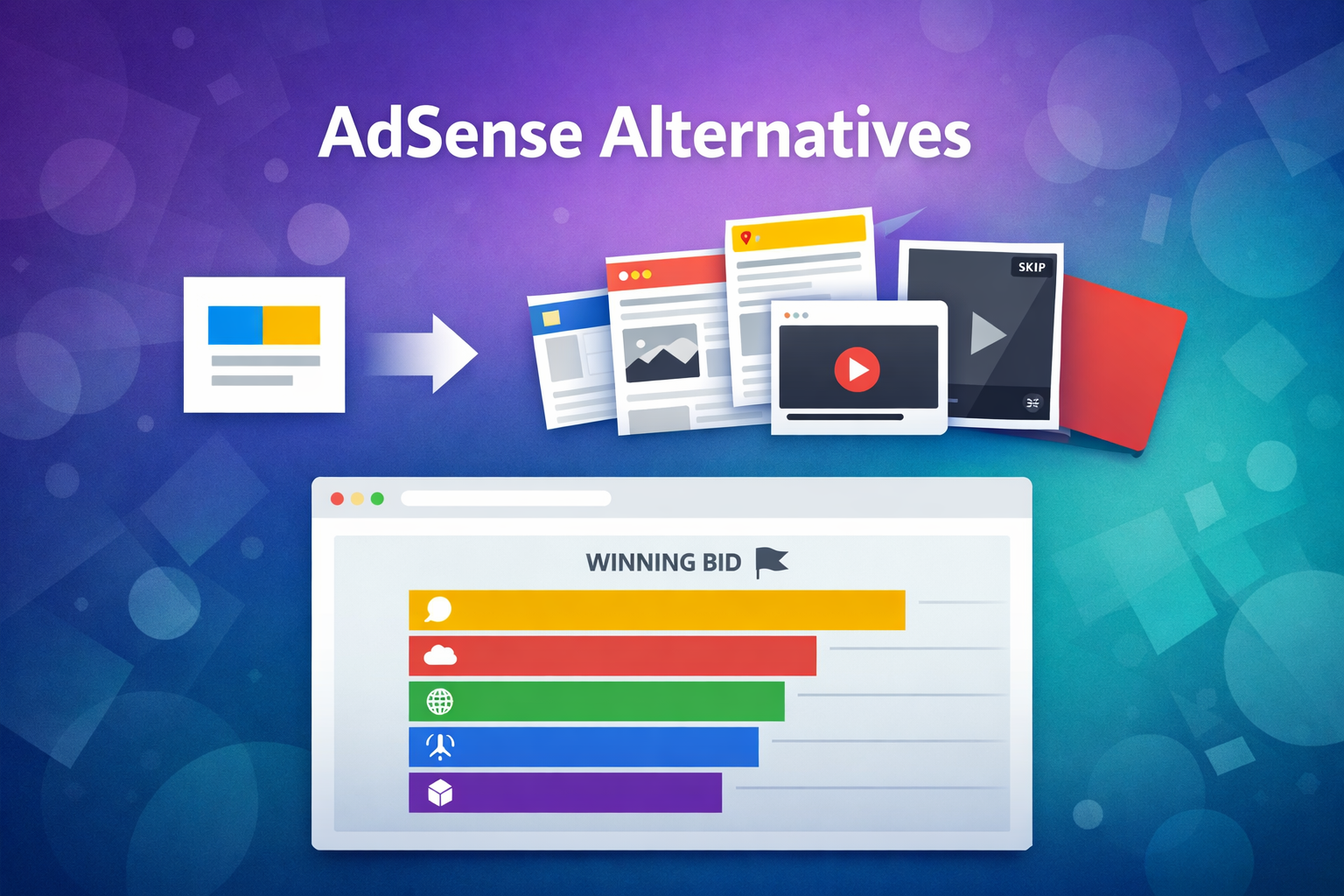
Google AdSense is the starting point for most publishers entering the world of ad monetization. It is easy to set up, has no minimum traffic requirements, and provides a reliable stream of revenue. But as your site grows, you may notice that AdSense revenue plateaus while your traffic keeps climbing.
That is the point where many publishers begin searching for AdSense alternatives that can deliver higher CPMs, more ad formats, and greater control over their ad inventory. The good news is that there is no shortage of options. The challenge is finding the right fit for your site’s traffic level, niche, and technical setup.
This guide breaks down the best Google AdSense alternatives for publishers in 2026, organized by category so you can quickly find what works for your situation.
Why Publishers Look for AdSense Alternatives
Before diving into alternatives, it helps to understand why publishers outgrow AdSense. The platform has clear strengths: it is free, easy to integrate, and backed by Google’s massive advertiser base. However, it also has significant limitations that become more apparent as your traffic grows.
Limited demand competition. AdSense runs a single auction from Google’s demand pool. Without competition from other demand sources, you are leaving money on the table. Header bidding platforms run simultaneous auctions across 20+ demand partners, which typically drives CPMs 20-70% higher than AdSense alone, with some publishers seeing even greater gains.
Limited control over ad formats. AdSense does offer several formats including display, in-feed, in-article, multiplex, anchor, and vignette ads. However, publishers have limited control over placement optimization, and the format selection is still narrower than what dedicated monetization platforms provide. Full-service platforms add custom sticky units, rewarded ads, custom native placements, video ads, and smart refresh capabilities that AdSense lacks.
No access to premium demand. AdSense does not give you access to multiple ad exchanges, where premium advertisers bid at significantly higher rates. Accessing them requires Google Ad Manager 360 or working with a Google Certified Publishing Partner (GCPP).
Limited reporting and optimization tools. AdSense provides basic revenue reporting but lacks the granular analytics needed to optimize ad performance.
No dedicated support. Unless you generate substantial revenue, AdSense support is largely self-service. When ad serving issues arise, you are on your own.
Types of AdSense Alternatives
Not all alternatives are created equal. They fall into distinct categories, each suited to different publisher needs:
- Full-service monetization platforms manage your entire ad stack, including header bidding, ad layout optimization, and demand partner management. These typically offer the highest revenue uplift but may require minimum traffic thresholds.
- Ad networks serve as intermediaries between publishers and advertisers. They are often easy to join but provide less optimization than full-service platforms.
- Native and content recommendation platforms specialize in content-style ad units that blend with your site’s editorial content.
- Direct ad marketplaces connect you directly with advertisers, eliminating the middleman but requiring more hands-on management.
The best approach for most growing publishers is to work with a full-service monetization platform that combines multiple demand sources through header bidding, Open Bidding and server-side auctions. Some partners allow you to keep AdSense as one competing demand partner.
Best Full-Service Monetization Platforms
Full-service platforms handle the heavy lifting of ad optimization. They manage header bidding setups, demand partner relationships, ad layout testing, and performance monitoring. For most publishers generating meaningful traffic, these deliver the biggest revenue improvement over AdSense.
1. Clickio
| Type | Full-service monetization platform (GCPP) |
| Min. traffic | 100,000 pageviews/month (US, UK, FR, CA, AU); higher for other regions. Sites earning $500+/month may qualify with lower traffic. |
| Demand partners | 20+ (Xandr, Magnite, Google, OpenX, PubMatic, Index Exchange, Criteo, and more) |
| Key features | Header bidding, Google AdX access, AI-driven price floors, 10+ ad formats, Core Web Vitals monitoring |
| AdSense mediation | Yes, zero commission on existing AdSense earnings |
| GCPP certified | Yes |
Clickio is a Google Certified Publishing Partner that provides publishers with a complete ad monetization stack through a single script integration. Instead of replacing AdSense, Clickio lets you keep your existing AdSense account competing alongside 20+ premium demand partners through header bidding (Prebid), Google Open Bidding, and server-to-server connections.
What sets Clickio apart is the combination of AI-driven price floor optimization, which adjusts minimum bids dynamically by country, device, format, and user engagement, and integrated Core Web Vitals monitoring that ensures ad placements do not harm your site’s page experience scores. Publishers also get access to Google AdX demand through Clickio’s Multiple Customer Management (MCM) setup, unified reporting that consolidates Clickio, AdSense, and Google Analytics data, and dedicated account management.
The platform supports over 10 ad formats including sticky horizontal and vertical units, interstitials, rewarded ads, native placements, and in-content units. Smart refresh and lazy loading are applied across all formats to maximize viewability and revenue without impacting page speed.
Clickio is also a Gold-tier Google CMP Partner and operates its own Consent Management Platform (CMP), helping publishers comply with global privacy regulations such as GDPR and CCPA. This means publishers can handle both monetization and consent management through a single partner.
2. Mediavine
| Type | Full-service monetization platform |
| Min. traffic | 1,000 sessions/month (Journey tier); $5,000 annual ad revenue (Official tier) |
| Key features | Pre-optimized ad templates, lazy loading, video player, tiered program |
| Best for | Lifestyle, food, travel, and DIY blogs |
Mediavine is a popular choice for lifestyle publishers and content creators. In early 2026, Mediavine restructured its programs: the entry-level Journey tier accepts publishers with as few as 1,000 monthly sessions, while the Official tier requires $5,000 in annual ad revenue and unlocks the full feature set. Mediavine is particularly strong in the food, travel, and parenting niches where it has deep advertiser relationships.
The main limitation is the niche focus. Publishers outside lifestyle verticals may find less optimized demand, and the platform offers less flexibility for custom ad implementations compared to more technical solutions.
3. Raptive (formerly AdThrive)
| Type | Full-service monetization platform |
| Min. traffic | 25,000 pageviews/month (50% from tier-one markets for smaller sites) |
| Key features | RPM Guarantee (for qualifying sites), premium advertiser access, creator tools |
| Best for | Content creators and blogs with US/UK traffic |
Raptive lowered its traffic requirement in late 2025 to just 25,000 monthly pageviews (down from 100,000), though sites under 100K pageviews need at least 50% of their traffic from tier-one markets (US, UK, Canada, Australia, New Zealand). The platform offers an RPM Guarantee for qualifying larger publishers who meet minimum revenue thresholds, promising at least a 15% RPM lift. Raptive has strong relationships with premium US advertisers, which makes it particularly effective for publishers with predominantly US-based traffic.
The tier-one market requirement means publishers with primarily non-English or developing-market traffic may not qualify. The platform is also less suited to news sites compared to platforms with broader demand partnerships.
4. Ezoic
| Type | Full-service monetization platform (GCPP) |
| Min. traffic | No minimum (10,000+ pageviews recommended) |
| Key features | AI-driven ad layout testing, Google AdX access, site speed tools |
| Best for | Small to medium publishers wanting automated optimization |
Ezoic uses machine learning to test thousands of ad placement combinations and find the layout that maximizes revenue per visitor. As a GCPP, it provides Google AdX access even for smaller sites. The absence of a strict traffic minimum makes it one of the most accessible full-service platforms.
The trade-off is that Ezoic’s automated approach can sometimes place ads in positions that impact user experience. Publishers who want fine-grained control over ad placement may find the automation limiting. Some publishers also report slower page load times compared to other solutions.
5. Monumetric
| Type | Full-service monetization platform |
| Min. traffic | 10,000 pageviews/month |
| Key features | Tiered plans (Propel, Ascend, Stratos, Apollo), dedicated support |
| Best for | Small publishers graduating from AdSense |
Monumetric stands out for its low 10,000 pageview minimum, making it accessible to smaller publishers ready to move beyond AdSense. The platform operates on a tiered system where services and features scale with your traffic. The lowest tier (Propel) charges a one-time $99 setup fee, while higher tiers waive this cost.
The tiered approach means the most powerful optimization features are only available to higher-traffic publishers. Smaller publishers on the Propel plan get a revenue improvement over AdSense but may not see the dramatic gains available on premium tiers.
Best Ad Networks and Contextual Platforms
If you are not ready for a full-service platform or want to supplement your existing setup with additional demand, these ad networks and contextual platforms are strong AdSense alternatives.
6. Media.net
| Type | Contextual ad network |
| Min. traffic | None (quality-based approval) |
| Payment threshold | $100 |
| Key features | Yahoo/Bing advertiser network, contextual targeting, display-to-search (D2S) ads |
| Best for | Content-heavy sites with English-language traffic |
Media.net is one of the largest contextual ad networks globally, powered by the Yahoo/Bing network. It serves contextual ads that match your page content, similar to how AdSense works. The unique display-to-search (D2S) format shows search-like ad units within your content, which often delivers higher click-through rates than standard display ads.
Media.net works best for English-language content targeting US, UK, and Canadian audiences. Publishers with predominantly non-English or developing-market traffic may see lower fill rates and CPMs.
7. Infolinks
| Type | In-text contextual ad network |
| Min. traffic | None |
| Payment threshold | $50 |
| Key features | In-text, in-fold, in-tag, and in-frame ad units |
| Best for | Text-heavy content sites wanting non-intrusive supplementary revenue |
Infolinks takes a different approach by turning keywords in your content into ad placements. When readers hover over highlighted words, contextual ads appear. This format does not compete with standard display ad placements, making Infolinks a good supplementary option alongside other ad partners. Revenue tends to be lower than display-based alternatives, but the non-intrusive format works well for content-heavy sites.
Best Native and Content Recommendation Platforms
Native ad platforms serve content recommendation widgets that blend with your site’s editorial design. They typically appear at the end of articles or within content feeds and earn revenue on a cost-per-click basis.
8. Taboola
| Type | Content recommendation / native ads |
| Min. traffic | 500,000 pageviews/month |
| Payment threshold | $100 |
| Key features | Content discovery widgets, 600M+ daily active users, video ads |
| Best for | News and editorial publishers with high traffic |
Taboola is one of the largest content recommendation platforms, serving sponsored content widgets that appear below articles. The platform reaches over 600 million daily active users through partnerships with major publishers. Taboola’s widgets can generate meaningful revenue, particularly for news sites with high pageview counts per visit.
The 500,000 pageview minimum makes Taboola accessible only to larger publishers. Smaller sites can access similar native formats through Taboola’s self-serve advertising platform or through monetization partners that integrate native demand alongside display.
9. Teads (formerly Outbrain)
| Type | Omnichannel advertising / native and video ads |
| Min. traffic | High (premium publisher network) |
| Payment threshold | Varies |
| Key features | inRead video ads, native placements, brand safety controls, cookieless targeting |
| Best for | Premium editorial publishers with significant traffic |
Teads acquired Outbrain in early 2025, creating one of the largest independent advertising platforms. The combined company offers publishers access to premium brand advertisers through native and video ad formats, including Teads’ signature inRead video units that play within editorial content. Teads works primarily with large, premium publishers and focuses on brand-safe, high-quality ad experiences.
The high traffic requirements and premium positioning mean Teads is not accessible to smaller publishers. However, for larger editorial sites, the platform’s direct relationships with major brand advertisers can deliver strong CPMs, particularly for video inventory.
Best Direct Ad Marketplaces
10. BuySellAds
| Type | Direct ad marketplace |
| Min. traffic | ~100,000 pageviews/month (evaluated case by case) |
| Payment threshold | $20 |
| Key features | Direct advertiser connections, Carbon Ads (developer/designer niche), email sponsorships |
| Best for | Tech, developer, and design-focused publishers |
BuySellAds operates as a marketplace where advertisers can directly purchase ad placements on your site. This model often yields higher CPMs than programmatic because advertisers choose your site specifically for its audience. BuySellAds is especially strong in the tech and developer space through its Carbon Ads network, which serves tasteful, non-intrusive ads favored by technical audiences.
The downside is that fill rates depend on advertiser demand for your specific niche. Sites outside tech and design verticals may struggle to attract enough direct buyers for consistent revenue.
Can You Use AdSense Alongside Alternatives?
Google’s AdSense policies allow publishers to use other ad networks alongside AdSense as long as the AdSense ad code is not modified and the overall ad experience complies with Google’s guidelines.
The most effective approach is using a monetization platform that supports AdSense mediation. This means your existing AdSense demand competes in the same auction as other demand partners. If AdSense bids the highest, it wins the impression. If another partner bids higher, they win instead. The result is that every impression goes to the highest bidder, maximizing your revenue.
Clickio’s monetization platform includes AdSense mediation with zero commission on AdSense earnings. Your existing AdSense account participates in the unified auction, and you keep 100% of whatever AdSense revenue it generates. This removes the risk of switching: your AdSense revenue stays the same or goes up, while the additional demand partners create an uplift on top.
How to Transition from AdSense to an Alternative
Switching from AdSense to a new monetization partner does not have to be a leap of faith. Follow these steps to make the transition smooth:
- Run a test period. Most reputable monetization platforms offer a trial period. Use it to compare revenue with your AdSense baseline. Ensure you compare like-for-like periods (same traffic levels, same time of year) for an accurate picture.
- Check Core Web Vitals impact. Add the new ad code and monitor your Core Web Vitals scores for any negative changes. Good monetization platforms should have a neutral or positive impact on page speed.
- Keep AdSense competing. Choose a platform that supports AdSense mediation so you do not lose your existing revenue floor. This is the safest way to transition since you are only adding revenue, not replacing it.
- Review reporting and support. Beyond raw revenue, evaluate the quality of analytics (can you see revenue by page, device, country?) and the responsiveness of the support team. These factors matter more over the long term than small differences in short-term CPMs.
- Update your ads.txt file. When adding new demand partners, update your ads.txt file to authorize their sellers. Your monetization partner should provide the required ads.txt entries.
Frequently Asked Questions
What pays more than Google AdSense?
Header bidding platforms that run simultaneous auctions across multiple demand partners consistently outperform AdSense. This includes full-service monetization platforms like Clickio, Mediavine, and Ezoic. The increased competition between demand sources typically drives CPMs 20-70% higher than AdSense alone, with some publishers seeing even greater improvements.
Can I use multiple ad networks at the same time?
Yes. Many publishers use a primary full-service monetization platform for display ads and supplement it with a native platform like Taboola or a contextual network like Infolinks. The key is choosing partners that do not conflict with each other’s ad placements and ensuring your total ad density complies with Google’s guidelines.
Will switching from AdSense hurt my Google rankings?
Switching ad networks does not directly affect your Google search rankings. However, if a new ad setup significantly worsens your Core Web Vitals (page load speed, layout stability), that could indirectly impact rankings through Google’s page experience signals. Choose a monetization partner that actively monitors and optimizes for Core Web Vitals.
What is the difference between an ad network and a monetization platform?
An ad network connects publishers with a pool of advertisers and serves ads from that single pool. A monetization platform goes further by managing multiple demand sources through header bidding, optimizing ad layouts, providing advanced analytics, and often including dedicated support. Monetization platforms typically deliver higher revenue because they create competition between many demand sources for each impression.
How long does it take to see results after switching?
Most publishers see initial results within the first week, but a fair comparison requires at least 30 days of data. Header bidding platforms need time to collect performance data and optimize bid strategies for your specific traffic. Seasonal factors, traffic fluctuations, and advertiser spending cycles also affect results, so comparing month-over-month performance gives the most accurate picture.