
What Is a Consent Management Platform (CMP)?
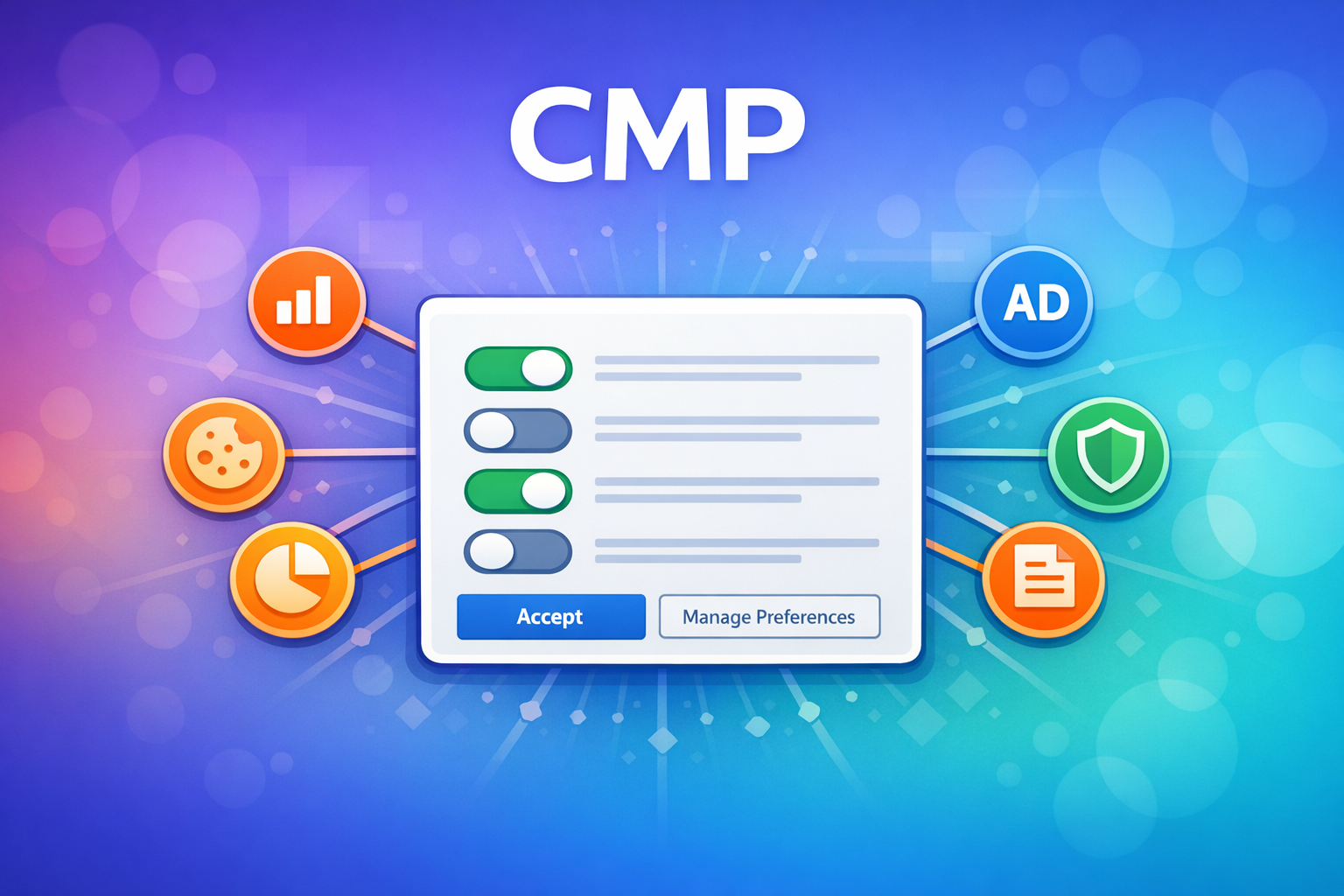
Privacy regulations like GDPR and CCPA require websites to obtain user consent before collecting personal data or using tracking technologies like cookies. But managing consent across different regions, regulations, and ad tech vendors is not something publishers can handle manually. That is where a consent management platform comes in.
A consent management platform (CMP) is a tool that helps websites collect, store, and manage user consent for data processing. In this guide, we explain how CMPs work, why every publisher needs one, and what features matter most when choosing a consent management solution.
What Is a Consent Management Platform?
A consent management platform (CMP) is a software solution that sits between your website and its visitors, handling the entire consent lifecycle. When a user lands on your site, the CMP displays a consent dialog – commonly known as a cookie banner – that explains what data is being collected, by whom, and for what purpose. The user can then accept, reject, or customize their consent preferences.
But a CMP does far more than show a popup. Behind the scenes, it:
- Records and stores each user’s consent choices as a legally valid record
- Signals those choices to ad tech vendors, analytics tools, and other third-party scripts on your site
- Blocks or allows scripts based on whether consent has been granted for the relevant purpose
- Handles regional differences – applying GDPR rules for European visitors, CCPA rules for Californians, and so on
- Provides reporting and analytics on consent rates, opt-in versus opt-out behavior, and user engagement with the consent dialog
In short, a CMP automates privacy compliance so publishers can focus on content and monetization rather than tracking the ever-changing landscape of global data protection laws.
Why Do Publishers Need a CMP?
For publishers who rely on advertising revenue, consent management is not optional – it is a business necessity. Here is why:
Legal Compliance
Under GDPR, websites must obtain explicit, informed consent before using cookies or other tracking technologies for purposes like advertising and analytics. The CCPA/CPRA requires offering a clear opt-out mechanism for the sale or sharing of personal information. Nearly 20 US states now have comprehensive privacy laws, including Virginia, Colorado, and Connecticut, each with their own requirements.
Without a CMP, meeting these requirements across multiple jurisdictions is practically impossible. A single website can have visitors from dozens of countries, each with different consent rules. A CMP handles this complexity automatically.
Ad Revenue Protection
Consent directly impacts how much money publishers earn from programmatic advertising. Without valid consent signals, ad exchanges and demand-side platforms (DSPs) cannot serve personalized ads – which typically command higher CPMs than non-personalized alternatives. A well-implemented CMP maximizes consent rates while remaining compliant, protecting your advertising revenue.
Google specifically requires publishers to use a Google-certified CMP to communicate consent signals to Google Ad Manager, AdSense, and Google Ads. Without proper consent integration, publishers risk losing access to Google demand entirely.
User Trust
A transparent, well-designed consent experience signals to visitors that you take their privacy seriously. Conversely, dark patterns – like burying the reject button or using confusing language – erode trust and can lead to regulatory enforcement action.
How Does a CMP Work?
Understanding the technical flow behind consent management helps publishers appreciate what their CMP is doing on every page load:
- Page load: The CMP script loads before any other tracking scripts. It checks whether the visitor has an existing consent record (stored in cookies or local storage).
- Consent check: If no consent record exists – either because it is a new visitor or the previous consent has expired – the CMP pauses all tracking scripts and displays the consent dialog.
- User choice: The visitor makes their selection. This could be accepting all purposes, rejecting non-essential ones, or customizing on a purpose-by-purpose or vendor-by-vendor basis.
- Signal distribution: The CMP encodes the consent choices into a standardized format (such as the IAB TC String) and makes them available to ad tech vendors and analytics tools via the TCF API.
- Script management: Based on the consent signals, the CMP unblocks approved scripts and keeps others paused. For example, if a user declines advertising cookies, the CMP ensures no advertising tracking scripts execute.
- Ongoing management: On subsequent visits, the CMP reads the stored consent record and applies the same script-blocking rules without showing the dialog again – until the consent expires or the publisher updates their vendor list.
Key CMP Features to Look For
Not all consent management platforms are equal. When evaluating a CMP for your publishing operation, these are the capabilities that matter most:
IAB Transparency and Consent Framework (TCF) Support
The IAB Transparency and Consent Framework is the industry standard for communicating consent signals in programmatic advertising. A TCF-registered CMP generates standardized TC Strings that ad exchanges, SSPs, and DSPs use to determine whether they can serve personalized ads.
Without TCF support, your consent signals will not be recognized by most programmatic buyers, which means lower fill rates and reduced CPMs. Look for a CMP that supports the latest version – currently TCF v2.3 – and is officially registered with IAB Europe.
Google Consent Mode v2
Google Consent Mode v2 is a framework that adjusts how Google tags (Analytics, Ads, Tag Manager) behave based on a visitor’s consent status. In its Advanced implementation, when consent is denied, Google tags send cookieless pings that Google uses for conversion modeling and behavioral estimation – allowing publishers to maintain measurement insights without violating user preferences. In Basic mode, no data is collected at all when consent is denied.
Since January 2024, Google requires publishers serving ads in the EEA and UK to use a Google-certified CMP. Consent Mode v2 support became a separate requirement around March 2024 for measurement and audience features. Without both, personalization and remarketing features are restricted, directly impacting ad revenue.
Your CMP should automatically communicate consent signals to Google services without requiring manual tag configuration.
Google CMP Partner Program Certification
Google maintains a list of certified CMP partners that meet its technical requirements for consent signal communication. Using a Google-certified CMP ensures that consent is properly communicated to all Google advertising and analytics products.
If your CMP is not Google-certified, you may find that Google Ad Manager or AdSense does not properly recognize consent signals – leading to revenue loss even when users have granted consent.
Multi-Regulation Support
A good CMP does not just handle GDPR. It should automatically detect visitor location and apply the correct regulatory framework:
- GDPR for visitors from the EU/EEA and UK – requiring explicit opt-in consent
- CCPA/CPRA for California residents – requiring a “Do Not Sell or Share” opt-out mechanism
- US state privacy laws for visitors from Virginia, Colorado, Connecticut, and other states with privacy legislation
- Global regulations like Brazil’s LGPD, the UK PECR, and others
This geo-aware approach ensures visitors see the right consent experience for their jurisdiction, without publishers needing to configure separate solutions for each region.
Vendor Management
Publishers typically work with dozens of ad tech vendors – SSPs, DSPs, analytics providers, header bidding partners, and more. A CMP should let you manage your vendor list, control which vendors are disclosed to users, and keep lists updated as the IAB Global Vendor List and Google’s Additional Third Party (ATP) list evolve.
Some CMPs offer optimized vendor lists that include only the vendors most relevant to your ad stack, which improves page load times and consent dialog UX compared to showing all 1,100+ registered TCF vendors.
Customization and Branding
The consent dialog is one of the first things visitors see on your site. Your CMP should offer customization options – colors, positioning, button labels, and text – so the dialog matches your brand and site design. Some CMPs also support multiple languages, which is essential for publishers with international audiences.
Reporting and Analytics
Data-driven publishers need visibility into how their consent dialogs perform. Look for a CMP that provides metrics on:
- Consent rates (what percentage of users accept, reject, or customize)
- Interaction rates (how many users engage with the dialog versus ignoring it)
- Regional breakdowns (consent behavior by country or regulation)
- Trends over time (how consent rates change after dialog design updates)
These insights help you optimize the consent experience to maintain high opt-in rates without compromising compliance.
CMP vs Cookie Banner: What Is the Difference?
The terms “cookie banner” and “consent management platform” are often used interchangeably, but they are not the same thing. A cookie banner is just the visible popup that asks users for consent. A CMP is the complete system behind that banner – handling consent storage, vendor signaling, script blocking, regulatory logic, and reporting.
Think of it this way: the cookie banner is the front door, while the CMP is the entire building. A simple cookie banner plugin might display a notice and drop a cookie, but it does not communicate with ad tech vendors via the TCF, it does not support Google Consent Mode v2, and it does not adapt to different privacy regulations based on visitor location.
For publishers who monetize through advertising, a full CMP – not just a cookie banner – is essential.
How to Choose the Right CMP
Selecting a consent management platform is an important decision that affects compliance, revenue, and user experience. Here is a practical checklist:
Certification and Standards
- Is the CMP registered with IAB Europe for TCF?
- Is it a Google-certified CMP partner?
- Does it support TCF v2.3 (the current version)?
- Does it support Google Consent Mode v2?
Regulatory Coverage
- Does it handle GDPR (opt-in) and CCPA (opt-out) with geo-detection?
- Does it cover US state privacy laws beyond California?
- Does it support Global Privacy Control (GPC) signals?
Technical Integration
- Does it integrate with your ad server (Google Ad Manager, AdSense)?
- Does it work with Google Tag Manager?
- Can it be implemented on your CMS, AMP pages, and mobile apps?
- Does it support script pausing and unpausing based on consent?
Publisher-Specific Features
- Does it offer vendor list management (optimized, full, or custom lists)?
- Does it provide consent rate reporting and analytics?
- Does it support multiple languages for international audiences?
- Can you customize the consent dialog design to match your brand?
- Does it offer A/B testing to optimize consent rates?
Common CMP Implementation Mistakes
Even with a solid CMP in place, publishers sometimes make mistakes that undermine compliance or hurt revenue:
- Pre-ticked consent boxes: Under GDPR, consent must be freely given and affirmative. Pre-selecting consent categories is not valid consent and can lead to enforcement action.
- No reject option on the first layer: Many data protection authorities have clarified that the option to reject non-essential cookies must be as easy to access as the option to accept. Hiding the reject button behind a “Manage preferences” link is a compliance risk.
- Not blocking scripts until consent is given: Displaying a cookie banner but loading tracking scripts anyway is a common and serious violation. The CMP must actually prevent scripts from firing until consent is obtained.
- Outdated vendor lists: The IAB Global Vendor List is updated weekly. If your CMP vendor list is outdated, you may be collecting consent for vendors no longer registered – or failing to disclose new vendors you are actually using.
- Ignoring non-EU regulations: GDPR gets the most attention, but CCPA/CPRA, US state privacy laws, and other global regulations also require consent or opt-out mechanisms. A CMP that only handles GDPR leaves publishers exposed elsewhere.
How Clickio Consent Works as a CMP
Clickio Consent is a consent management platform built specifically for publishers. It is registered with IAB Europe (CMP ID 63) and holds Gold-tier certification from Google as part of the Google CMP Partner Program – the highest level, recognizing exceptional product quality and publisher support, ensuring that consent signals are properly recognized across the entire programmatic advertising ecosystem.
Key capabilities include:
- TCF v2.3 and Google Consent Mode v2 – full support for the latest industry standards, with automatic consent signal communication to Google services
- Multi-regulation compliance – handles GDPR, CCPA/CPRA, US state privacy laws, and other global privacy regulations with automatic geo-detection
- Optimized vendor management – choose between a curated list of vendors optimized for performance, the full TCF and Google vendor list, or a custom selection tailored to your ad stack
- 26+ languages – automatic localization for international audiences
- Consent analytics – detailed reporting on consent events, opt-in rates, and user interactions
- Multi-platform support – works on websites, AMP pages, and mobile apps (with native SDKs for Android, iOS, Flutter, and React Native)
- Customizable design – match the consent dialog to your brand with color, positioning, text, and button customization
Clickio Consent offers a free tier to get started, with paid plans for additional features like vendor management, A/B testing, built-in cookie paywall, and mobile app SDKs.
Frequently Asked Questions
Is a CMP required by law?
GDPR and the ePrivacy Directive require websites to obtain consent before using non-essential cookies and tracking technologies. While the law does not mandate using a “CMP” specifically, it mandates the consent collection, storage, and signaling functions that a CMP provides. In practice, meeting these requirements without a CMP is not feasible for any publisher running advertising.
What is the difference between a CMP and a cookie consent plugin?
A basic cookie consent plugin typically just shows a banner and records whether the user clicked “accept.” A CMP goes further – it integrates with the IAB TCF to communicate consent to ad tech vendors, supports Google Consent Mode v2, blocks scripts until consent is given, handles multiple regulations with geo-detection, and provides analytics on consent performance.
Does my CMP need to be Google-certified?
If you use any Google advertising or analytics products – including Google Ad Manager, AdSense, Google Analytics, or Google Ads – then yes, you need a Google-certified CMP. Since January 2024, Google requires this for publishers serving ads to users in the EEA and UK.
What is Google Consent Mode v2?
Google Consent Mode v2 is a feature that adjusts Google tag behavior based on user consent. In Advanced mode, when a visitor declines consent, Google tags send cookieless pings – without persistent identifiers – that Google uses for conversion modeling and behavioral estimation. In Basic mode, no data is collected when consent is denied. A Google-certified CMP handles Consent Mode v2 automatically.
Can I use a free CMP?
Yes. Several CMPs, including Clickio Consent, offer free tiers that include core compliance features like TCF support and Google Consent Mode v2. Free plans may have limitations on traffic volume, the number of sites, or advanced features like vendor management and A/B testing. For most small publishers, a free plan provides a solid starting point.
Conclusion
A consent management platform is no longer a nice-to-have for publishers – it is essential infrastructure. With GDPR, CCPA, and a growing number of privacy regulations worldwide – from Brazil’s LGPD to India’s DPDPA – publishers need a robust, certified CMP to stay compliant, protect ad revenue, and maintain user trust.
When choosing a CMP, prioritize IAB TCF registration, Google certification, Google Consent Mode v2 support, multi-regulation coverage, and consent analytics. These are the features that directly impact both your compliance posture and your bottom line.
Clickio Consent checks all of these boxes as a Gold-tier Google-certified, IAB-registered CMP trusted by over 2,000 publishers worldwide. Get started today with a free account and see how proper consent management can protect your revenue while keeping you compliant.