
How to Monetize a Website: Complete Guide for Publishers
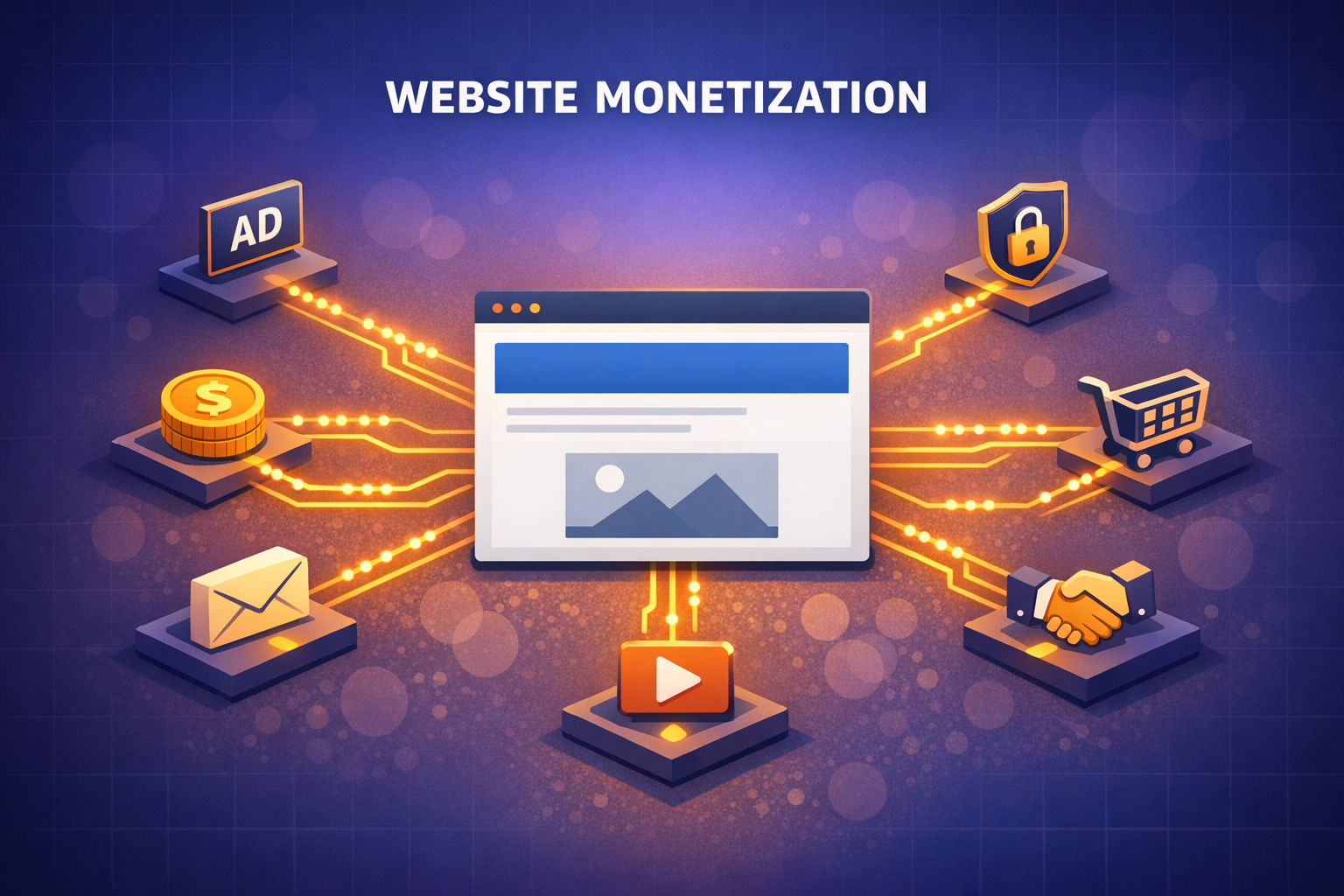
Every publisher eventually faces the same question: how do you turn website traffic into sustainable revenue? Whether you run a news site, a niche blog, or a large content network, the answer is rarely a single strategy. The most successful publishers combine multiple monetization methods – advertising, subscriptions, affiliate partnerships, and direct deals – tailored to their audience and content.
This guide walks through every major website monetization strategy, explains how each one works, and helps you decide which combination will maximize your revenue.
What Is Website Monetization?
Website monetization is the process of generating revenue from your website’s traffic. It includes any method that converts visitors, pageviews, or engagement into income – from display ads and programmatic auctions to paid subscriptions and sponsored content.
For most publishers, advertising is the primary revenue source. But the landscape has grown far more sophisticated than simply pasting an AdSense code on your pages. Modern monetization involves header bidding, programmatic advertising, price floor optimization, and multiple demand sources competing for every impression.
Display Advertising: The Foundation of Publisher Revenue
Display advertising remains the most common way publishers monetize websites. Advertisers pay to show banner ads, video ads, native ads, and other formats to your visitors. Revenue is typically measured in CPM (cost per mille – the price per 1,000 impressions) or RPM (revenue per mille – your earnings per 1,000 pageviews).
Google AdSense
Google AdSense is where most publishers start. It’s free, easy to set up, and requires no minimum traffic. Google matches ads to your content and handles billing – you simply add a code snippet to your site.
However, AdSense has significant limitations. It offers a limited set of ad formats, no access to premium demand, and no control over price floors or auction dynamics. As your traffic grows, you’ll likely find that AdSense alone leaves significant revenue on the table. That’s why many publishers eventually explore AdSense alternatives that offer more advanced monetization technology.
Ad Networks
Ad networks aggregate inventory from multiple publishers and sell it to advertisers. They act as intermediaries, matching available ad space with advertiser campaigns. Some networks specialize in specific verticals (e.g., technology, finance, lifestyle), while others operate across categories.
The advantage of ad networks is simplicity – you connect once and gain access to a pool of advertisers. The downside is that they typically take a cut and may not maximize competition for each impression the way programmatic auctions do.
Programmatic Advertising and Header Bidding
Programmatic advertising automates the buying and selling of ad inventory through real-time auctions. Instead of negotiating deals manually, algorithms match advertisers with available impressions in milliseconds.
The most impactful advancement for publishers has been header bidding, which allows multiple demand-side platforms (DSPs) and ad exchanges to bid on your inventory simultaneously. This creates genuine competition for every impression and typically increases CPMs by 20-50% compared to a traditional waterfall setup.
Key components of the programmatic ecosystem include:
- Ad exchanges – digital marketplaces where publishers and advertisers trade inventory in real time
- DSPs (demand-side platforms) – tools advertisers use to bid on impressions across multiple exchanges
- SSPs (supply-side platforms) – tools publishers use to manage and sell their inventory
- Google Ad Manager – the ad server that orchestrates which ads appear on your site
- Supply path optimization (SPO) – ensuring the most efficient path between advertiser spend and publisher inventory
Ad Formats That Drive Revenue
The ad formats you use significantly impact both revenue and user experience. Modern publishers go well beyond standard banner ad sizes to include high-viewability formats:
- Sticky ads – remain visible as users scroll, delivering high viewability and consistent impressions
- In-article (smart) ads – placed dynamically within content for seamless integration and strong click-through rates
- Interstitial ads – full-screen overlays triggered between page transitions, delivering premium CPMs
- Native ads – styled to match your site’s look and feel, blending into the content experience
- Rewarded ads – users voluntarily engage in exchange for access to gated content or features
The right format mix depends on your site layout, content type, and audience behavior. A news site might rely on sticky and in-article formats, while a gaming site could benefit heavily from rewarded and interstitial ads.
Full-Service Monetization Platforms
For publishers who want to maximize ad revenue without building their own ad tech stack, full-service monetization platforms handle everything: header bidding setup, demand partner management, ad format optimization, price floor tuning, and ongoing performance improvements.
Clickio’s monetization platform, for example, combines AI-powered optimization with a full stack of ad formats, 20+ premium demand partners (including Google AdX, Xandr, Magnite, OpenX, PubMatic, Index Exchange, and Criteo), and dedicated AdOps specialists. Publishers integrate a single script and gain access to header bidding, open bidding, server-to-server auctions, smart ad refresh, lazy loading, and price floor optimization – all managed through one dashboard.
Clickio also offers AdSense Mediation, which lets publishers keep their existing AdSense account while adding Clickio’s demand sources. AdSense competes against Clickio’s partners for each impression, and the publisher pays zero commission on AdSense earnings.
Subscription and Membership Models
Subscriptions offer publishers a recurring, predictable revenue stream that doesn’t depend on ad market fluctuations. Readers pay a monthly or annual fee for access to premium content, an ad-free experience, or exclusive features.
Paywalls
Paywalls restrict access to some or all content behind a subscription. The three main types are:
- Hard paywall – all content requires a subscription (e.g., The Wall Street Journal). Works best for publishers with highly specialized, irreplaceable content.
- Metered paywall – readers get a set number of free articles per month before hitting the paywall (e.g., The New York Times). Balances reach with revenue.
- Freemium paywall – some content is always free, while premium articles or features require a subscription. Lets publishers maintain SEO traffic while monetizing their best content.
Membership Programs
Membership goes beyond content access. Members might receive newsletters, community access, early content, events, or direct interaction with authors. Platforms like Patreon, Memberful, and Ghost make it straightforward to set up tiered membership programs.
Subscriptions work best when your audience is loyal, your content is differentiated, and readers can’t easily find the same information elsewhere. For most ad-supported publishers, subscriptions complement rather than replace advertising revenue.
Affiliate Marketing
Affiliate marketing earns you a commission when readers purchase a product or service through your referral link. It’s performance-based – you only earn when a conversion happens – which means it pairs well with high-intent content like reviews, comparisons, and buying guides.
How Affiliate Marketing Works for Publishers
- Join an affiliate program or network (Amazon Associates, ShareASale, CJ Affiliate, Impact, etc.)
- Get unique tracking links for products or services relevant to your audience
- Integrate those links naturally into your content – reviews, recommendations, resource pages
- Earn a commission (typically 3-30% depending on the program) when a reader clicks through and makes a purchase
Best Practices
- Relevance first – only recommend products your audience actually needs. Irrelevant affiliate links erode trust.
- Disclose clearly – regulatory requirements (FTC in the US, ASA in the UK) mandate transparent disclosure of affiliate relationships.
- Focus on evergreen content – “best X for Y” guides, product comparisons, and tutorials generate affiliate revenue for months or years.
- Track performance – monitor which links and pages convert best, and optimize accordingly.
Affiliate marketing works particularly well for niche sites with a focused audience. A technology review site, for example, can earn substantial commissions on hosting, software, and hardware recommendations.
Sponsored Content and Direct Deals
Sponsored content involves creating articles, videos, or other content in partnership with a brand. Unlike display ads, sponsored content is integrated into your editorial flow – though it must be clearly labeled as sponsored to comply with advertising standards and maintain reader trust.
Types of Sponsored Content
- Sponsored articles – brand-funded posts on a topic relevant to both the advertiser and your audience
- Product reviews – paid reviews (clearly disclosed) of a brand’s product or service
- Newsletter sponsorships – brands sponsor a section of your email newsletter
- Podcast sponsorships – if you produce audio content, brands pay for host-read or pre-recorded ad spots
Direct Ad Deals
Beyond sponsored content, publishers can sell ad placements directly to advertisers. Direct deals typically command higher CPMs than programmatic because the advertiser is buying guaranteed placement on a specific site, often with custom creative or exclusive positioning.
Direct deals work best for publishers with a well-defined audience that advertisers want to reach. You’ll need a media kit, rate card, and the ability to traffic campaigns – either through your own Google Ad Manager setup or through your monetization partner.
E-commerce and Digital Products
Some publishers diversify revenue by selling products directly to their audience:
- Digital products – e-books, courses, templates, toolkits, or premium data sets related to your niche
- Physical merchandise – branded products for publishers with strong brand identity
- Events and webinars – paid or sponsored virtual and in-person events
- Tools and SaaS – if your expertise extends to software, building tools for your audience creates a high-margin revenue stream
E-commerce works best when the product is a natural extension of your content. A cooking site selling recipe books, a finance site offering planning templates, or a tech site selling online courses are all examples of content-product alignment.
Donations and Crowdfunding
For independent publishers, community-supported journalism, and niche content creators, reader donations can provide meaningful revenue. Platforms like Buy Me a Coffee, Ko-fi, and Patreon make it easy to accept voluntary contributions.
Donation models tend to work best when the publisher has a strong personal brand, a dedicated community, and content that readers feel compelled to support – independent journalism, educational content, and open-source tools are common examples.
Email Newsletters as a Revenue Channel
Email newsletters have re-emerged as a powerful monetization channel. A well-built email list gives publishers direct access to their audience – independent of search algorithms or social media platforms.
Newsletter monetization strategies include:
- Paid subscriptions – premium newsletters behind a paywall (Substack, beehiiv, Ghost)
- Sponsorships – brands pay for dedicated sections or mentions in your newsletter
- Affiliate links – curated product recommendations with tracking links
- Traffic driver – newsletters drive loyal visitors back to your site, increasing ad impressions and engagement metrics
How to Choose the Right Monetization Strategy
No single monetization method works for every publisher. The right approach depends on several factors:
| Factor | Impact on Strategy |
|---|---|
| Traffic volume | High-traffic sites earn more from ads; low-traffic sites may benefit more from affiliate, subscriptions, or digital products |
| Audience intent | Informational traffic favors ads; transactional traffic favors affiliate and e-commerce |
| Content type | News and evergreen content monetize well with ads; specialized/expert content supports subscriptions |
| Niche | Finance and technology have high CPMs; lifestyle and entertainment have lower CPMs but higher volume |
| Audience loyalty | High repeat-visit rates make subscriptions and memberships viable |
| Geographic distribution | Tier-1 traffic (US, UK, CA, AU) commands higher ad CPMs; global traffic benefits from volume-based strategies |
Revenue Potential by Strategy
| Strategy | Revenue Model | Best For | Effort to Start |
|---|---|---|---|
| Display ads (basic) | CPM / CPC | Any publisher with traffic | Low |
| Programmatic + header bidding | CPM (optimized) | Publishers with 50K+ monthly pageviews | Medium (or low with a managed partner) |
| Affiliate marketing | Commission per sale | Niche sites, review/comparison content | Low-medium |
| Subscriptions | Recurring fees | Specialized, high-value content | Medium-high |
| Sponsored content | Flat fee per post | Publishers with strong brand authority | Medium |
| Digital products | One-time or recurring | Expert/education sites | High |
| Email newsletters | Sponsorships, subscriptions | Publishers with engaged email lists | Medium |
Maximizing Ad Revenue: Key Optimization Strategies
Since advertising remains the dominant revenue source for most publishers, optimizing your ad setup is often the highest-impact action you can take. Here are the strategies that make the biggest difference:
1. Use Header Bidding
If you’re still relying on a single demand source (like AdSense alone), you’re almost certainly undermonetizing. Header bidding creates a unified auction where multiple demand partners compete simultaneously, driving up CPMs. It’s the single most impactful change a publisher can make to increase ad revenue.
2. Optimize Ad Placements and Formats
Where and how you place ads matters as much as who fills them. Key principles:
- Place at least one ad unit above the fold for strong viewability
- Use standard IAB banner sizes (300×250, 728×90, 336×280, 320×100) for maximum demand
- Add sticky formats for consistent viewability throughout the user session
- Deploy in-article ads in long-form content to capture scrolling users
- Test interstitials (with appropriate frequency caps) for premium CPMs
3. Implement Price Floor Optimization
Price floors set minimum bid thresholds for your inventory. When optimized dynamically – adjusting by geography, device, time of day, and ad format – they prevent inventory from selling below its true value and increase overall auction competition.
4. Focus on Core Web Vitals
Page speed and user experience directly affect ad revenue. Slow-loading pages lose visitors before ads even render, and Google factors Core Web Vitals into search rankings. Techniques like lazy loading ads, minimizing layout shift, and using efficient ad scripts protect both your SEO traffic and your ad viewability.
5. Diversify Demand Sources
Relying on a single ad network or exchange leaves money on the table and creates risk. A diversified demand stack – combining Google AdX, multiple SSPs, and direct deals – ensures you’re capturing the highest possible bid for every impression. Supply path optimization helps ensure this complexity works efficiently.
6. Monitor Key Metrics
Track the metrics that actually matter for publisher revenue:
- CPM – what advertisers pay per 1,000 impressions
- RPM – your revenue per 1,000 pageviews (accounts for fill rate and ad density)
- CTR – click-through rate, which affects both revenue and advertiser satisfaction
- Viewability – the percentage of impressions actually seen by users (industry benchmark: 70%+)
- Fill rate – how often your ad slots are filled with a paid ad
Combining Multiple Revenue Streams
The most resilient publishers don’t depend on a single revenue source. A diversified approach protects against market fluctuations (ad CPMs drop seasonally in Q1, for example) and captures revenue from different audience segments.
Here’s how different publisher types might combine strategies:
News and Media Sites
- Primary: Programmatic display ads with header bidding
- Secondary: Metered paywall for premium content
- Supplementary: Newsletter sponsorships, sponsored content
Niche Content Sites
- Primary: Affiliate marketing (product reviews, comparisons)
- Secondary: Display ads with header bidding
- Supplementary: Digital products (guides, templates), email newsletter
Large Content Networks
- Primary: Full programmatic stack (header bidding, open bidding, S2S) via a managed platform
- Secondary: Direct advertising deals
- Supplementary: Data monetization, events, licensing
Blogs and Creator Sites
- Primary: Display ads + affiliate links
- Secondary: Membership/Patreon
- Supplementary: Sponsored content, digital products, donations
Common Monetization Mistakes to Avoid
Monetization is about more than maximizing short-term revenue. These common mistakes can hurt your earnings over time:
- Overloading pages with ads – too many ads degrade user experience, increase bounce rates, and can trigger Google penalties. Balance ad density with readability.
- Ignoring mobile optimization – mobile traffic typically accounts for 60-70% of visits. If your ad setup isn’t optimized for mobile devices and screen sizes, you’re leaving the majority of your revenue unoptimized.
- Sticking with AdSense only – AdSense is a great starting point, but publishers with meaningful traffic almost always earn more with header bidding and multiple demand sources.
- Neglecting page speed – heavy ad scripts and unoptimized implementations hurt Core Web Vitals, which affects both SEO rankings and ad viewability.
- Not tracking revenue per page – not all pages earn equally. Knowing which content drives the most revenue helps you prioritize content creation and promotion.
- Ignoring consent and compliance – privacy regulations like GDPR and CCPA require proper consent management. Non-compliance can result in fines and loss of ad demand from compliant advertisers.
Getting Started: A Step-by-Step Approach
If you’re starting from scratch or rethinking your monetization strategy, here’s a practical roadmap:
- Assess your traffic – understand your monthly pageviews, geographic distribution, device breakdown, and audience demographics. These determine which strategies are viable.
- Start with display ads – set up a basic ad implementation. If you’re below 50K monthly pageviews, AdSense is a reasonable starting point. Above that, consider a managed monetization platform.
- Upgrade to header bidding – once you have consistent traffic, implementing header bidding (either self-managed or through a partner like Clickio) is the highest-ROI step.
- Optimize formats and placements – test different ad formats, positions, and densities. Use A/B testing to find the balance between revenue and user experience.
- Add complementary revenue streams – based on your content and audience, layer in affiliate links, sponsored content, or a subscription tier.
- Monitor and iterate – review key metrics weekly, test new formats quarterly, and stay current with industry changes.
Conclusion
Monetizing a website effectively requires more than placing ads and hoping for the best. The most successful publishers treat monetization as an ongoing practice – testing strategies, optimizing technology, diversifying revenue streams, and always balancing earnings against user experience.
For publishers focused on advertising revenue, the gap between a basic AdSense setup and a fully optimized programmatic stack with header bidding, multiple demand sources, and advanced ad formats is substantial – often 2-5x in revenue. Whether you build that stack yourself or partner with a platform like Clickio that manages it for you, the investment in proper monetization technology pays for itself many times over.