
What Is Programmatic Advertising? A Publisher’s Guide
More than 90% of all digital display advertising is now bought and sold programmatically. If you are a publisher earning revenue from ads, the vast majority of your income flows through programmatic systems – whether you realize it or not.
Yet many publishers treat programmatic as a black box. They connect their inventory to an ad network or monetization partner and hope for the best, without understanding how the auction mechanics, deal types, and ecosystem components actually affect their earnings.
This guide explains what programmatic advertising is, how it works from the publisher’s side, the different deal types you should know about, and what you can do to earn more from your programmatic inventory.
What Is Programmatic Advertising?
Programmatic advertising is the automated buying and selling of digital ad inventory using software platforms. Instead of negotiating deals manually with individual advertisers, publishers make their ad space available through technology platforms that match supply with demand in real time.
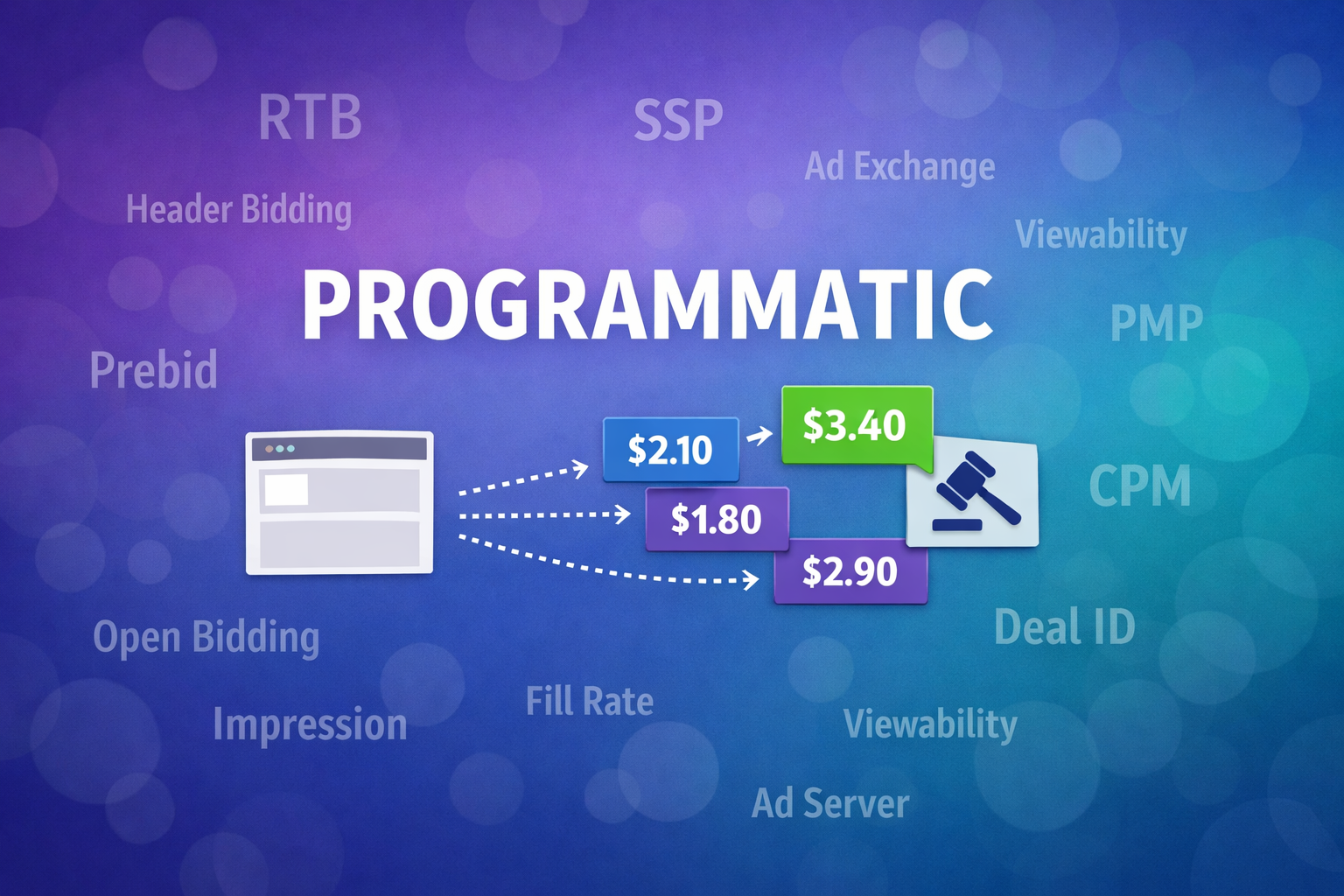
The core idea is simple: every time a user loads your webpage, the available ad slots are offered to a pool of potential buyers. These buyers evaluate the impression – who the user is, what page they are on, what device they are using – and decide whether and how much to bid. The highest bidder wins, their ad is displayed, and you get paid. The entire process takes roughly 100-200 milliseconds.
Before programmatic existed, publishers sold their ad inventory through direct sales teams or via ad networks that aggregated inventory from many sites and sold it in bulk at fixed prices. This was slow, labor-intensive, and often left revenue on the table because there was no competition for individual impressions. Programmatic changed this by introducing auction-based pricing where multiple buyers compete for every impression.
Today, programmatic advertising accounts for approximately 90% of all digital display ad spending. For publishers, it has become the default way ad inventory is monetized.
How Programmatic Advertising Works
To understand how programmatic affects your revenue, it helps to see what happens in the fraction of a second between a user arriving on your page and an ad appearing on screen.
The Programmatic Auction Flow
- User visits your page. As the page loads, your ad server (typically Google Ad Manager) identifies the available ad slots and sends out bid requests.
- Bid requests are broadcast. Your supply-side platform (SSP) packages information about the impression – the page URL, ad slot size, user data (if consent is given), device type, geography – and sends it to ad exchanges and demand-side platforms (DSPs).
- Advertisers evaluate and bid. DSPs on the buyer side evaluate the impression against their campaign criteria. If the impression matches what an advertiser wants (the right audience, the right context, the right geography), the DSP submits a bid.
- The auction runs. The ad exchange collects all bids and selects a winner. Most exchanges now use first-price auctions, meaning the winner pays exactly what they bid.
- The ad is served. The winning creative is sent to the user’s browser and rendered in the ad slot. The impression is logged and the publisher earns revenue.
With header bidding – the dominant auction model for web publishers today – multiple SSPs and exchanges run their auctions simultaneously before the ad server makes a final decision. This maximizes competition because every demand source gets a fair chance to bid on every impression, rather than being called in a sequential “waterfall” where the first responder wins by default.
The Programmatic Ecosystem: Key Components
Programmatic advertising involves several interconnected technology platforms. As a publisher, you do not need to manage all of these directly – your monetization partner typically handles the technical integration – but understanding what each component does helps you make better decisions about your ad setup.
Supply-Side Platform (SSP)
The SSP is the publisher’s technology platform. It connects your ad inventory to ad exchanges and manages the selling process on your behalf. SSPs handle bid request packaging, price floor management, brand safety filters, and deal configurations. Major SSPs include Google AdX, Magnite, PubMatic, Index Exchange, and OpenX.
Most publishers connect to multiple SSPs simultaneously through header bidding. The more SSPs you are connected to, the more demand sources compete for your inventory, which typically drives up CPMs.
Demand-Side Platform (DSP)
A DSP is the advertiser’s buying platform. Advertisers use DSPs to set targeting criteria (audience, geography, device, context), budget limits, and bidding strategies across multiple ad exchanges simultaneously. Major DSPs include Google DV360, The Trade Desk, Amazon DSP, and Xandr.
For publishers, the key point is that more DSPs connected to your supply means more competition for your impressions and higher revenue. This is why working with multiple SSPs matters – each SSP connects you to a different set of DSP buyers.
Ad Exchange
An ad exchange is the marketplace where the actual auction happens. It sits between SSPs (sell side) and DSPs (buy side), collecting bids and determining winners. Google Ad Exchange (AdX) is the dominant exchange for web publishers, but others like Magnite, OpenX, and PubMatic also operate their own exchange platforms.
In practice, the lines between SSPs and ad exchanges have blurred – many SSPs now run their own exchanges, functioning in both roles simultaneously.
Ad Server
The ad server is the central command system that decides which ad to show in each slot. For most publishers, this is Google Ad Manager (GAM). The ad server manages all deal priorities, mediates between direct campaigns and programmatic demand, handles delivery pacing, and provides unified reporting across all revenue sources.
Types of Programmatic Deals
Not all programmatic transactions work the same way. There are four main deal types, each offering a different balance of price certainty, volume commitment, and buyer access. Understanding these helps you decide how to structure your ad monetization strategy.
1. Open Auction (RTB)
The open auction, also known as real-time bidding (RTB), is the most common form of programmatic buying. Any qualified advertiser can bid on any available impression. There is no pre-negotiated deal, no fixed price, and no volume commitment – every impression is sold to the highest bidder in real time.
How it works for publishers: You make your inventory available through one or more SSPs, set price floors (minimum bids), and let the market determine the price. Open auctions maximize the number of potential buyers competing for your impressions.
Best for: Filling remaining inventory after higher-priority deals, and as a baseline revenue source that ensures every impression is monetized.
2. Private Marketplace (PMP)
A private marketplace is an invitation-only auction where only selected advertisers can participate. The publisher and buyer agree on a Deal ID, which grants the buyer access to specific inventory segments at negotiated price floors.
How it works for publishers: You set up deals with specific advertisers or agencies, typically at higher floor prices than open auctions. The buyer gets first access to your premium inventory, but there is no volume guarantee – the buyer can choose to pass on individual impressions.
Best for: Premium inventory where you want higher CPMs and more control over which brands appear on your site. PMP spending grew nearly 13% in 2025 as both publishers and advertisers shift away from the open auction toward more controlled environments.
3. Programmatic Guaranteed
Programmatic guaranteed is the closest deal type to a traditional direct sale. The publisher and advertiser agree on a fixed price and a guaranteed number of impressions, but the delivery is automated through programmatic pipes rather than manual ad trafficking.
How it works for publishers: You negotiate price and volume with the buyer, then set up the deal in your ad server. The system handles delivery, pacing, and reporting automatically. You get the revenue predictability of a direct deal with the operational efficiency of programmatic.
Best for: Publishers with strong direct sales teams who want to automate the execution of guaranteed deals. Also valuable for high-value sponsorships and brand partnerships.
4. Preferred Deals
A preferred deal gives a specific advertiser first-look access to your inventory at a pre-negotiated fixed price. If the buyer passes on an impression, it falls through to the open auction or PMP.
How it works for publishers: You agree on a fixed CPM with a buyer. That buyer gets priority access to your inventory before anyone else, but they are not obligated to buy every impression. It sits between a PMP (auction-based) and programmatic guaranteed (fully committed).
Best for: Building relationships with premium advertisers who want exclusive access without the commitment of a guaranteed deal.
Deal Type Comparison
| Deal Type | Pricing | Volume Guarantee | Buyer Access |
|---|---|---|---|
| Open Auction (RTB) | Dynamic (auction) | None | Any buyer |
| Private Marketplace | Floor price + auction | None | Invited buyers only |
| Preferred Deal | Fixed CPM | None | Single buyer (first look) |
| Programmatic Guaranteed | Fixed CPM | Guaranteed | Single buyer |
Header Bidding: How Modern Publishers Run Programmatic
The auction model has evolved significantly over the past decade. Understanding this evolution explains why your monetization setup matters so much.
The Waterfall Problem
In the early days of programmatic, publishers used a sequential “waterfall” model. The ad server would call demand sources one at a time, in a predetermined order. If the first source could not fill the impression at the floor price, it was offered to the second, then the third, and so on.
The problem was that a buyer lower in the waterfall might have been willing to pay more than the winning buyer at the top, but never got the chance to bid. This left significant revenue on the table.
How Header Bidding Solved It
Header bidding flattened the auction by allowing all demand sources to bid simultaneously, before the ad server makes a decision. Every SSP and exchange sees every impression at the same time, submits their best bid, and the highest bid wins.
This creates a true, unified auction where every buyer competes on equal footing. The result is consistently higher CPMs because competition is maximized for every impression.
There are two approaches to header bidding:
- Client-side header bidding (e.g. Prebid.js) runs the auction in the user’s browser. It is transparent and flexible, but adds some page load latency and is limited by browser resources. This remains the most widely adopted approach among publishers running header bidding.
- Server-side header bidding (e.g. Google Open Bidding, Prebid Server) runs the auction on a dedicated server. It is faster because the browser does not need to call each demand partner individually, and it can support more partners. However, it can have lower cookie match rates, which may slightly reduce targeting effectiveness.
In practice, most well-optimized publisher setups use a hybrid approach – client-side Prebid for web with server-side integrations (Open Bidding, server-to-server) for additional demand. This maximizes competition while keeping page performance in check.
Key Challenges in Programmatic Advertising
Programmatic is not without its challenges. Being aware of these issues helps you choose the right partners and protect your revenue.
Ad Fraud
Invalid traffic (IVT) – including bots, click farms, and fake impressions – costs the industry tens of billions of dollars annually, with estimates ranging from $41 billion to over $80 billion depending on the source and methodology. For publishers, ad fraud devalues your inventory and can lead to account suspensions or clawbacks from ad platforms.
Protection measures: Implement ads.txt and sellers.json to verify authorized sellers, work with partners that use IVT detection, and monitor your traffic for anomalies.
Transparency and the “Tech Tax”
A significant share of programmatic ad spend is absorbed by intermediaries before it reaches publishers. A 2023 ANA study found that approximately 29% of advertiser spending goes to DSPs, SSPs, exchanges, and data providers – meaning publishers receive about 71 cents of every dollar spent. This “tech tax” has prompted advertisers to pursue supply path optimization (SPO), cutting out unnecessary intermediaries and favoring publishers with clean, direct supply paths.
For publishers, this means working with reputable partners who maintain transparent supply chains and prioritize direct integrations with major DSPs.
Brand Safety
Advertisers are increasingly cautious about where their ads appear. Broad keyword blocklists can suppress CPMs for legitimate publishers covering sensitive topics (news, health, finance). PMPs and curated marketplaces help by giving advertisers confidence about the context where their ads will appear, which often results in higher bids.
Privacy and Consent
Privacy regulations like GDPR, CCPA, and LGPD directly affect programmatic revenue. Without valid user consent, many demand sources cannot bid effectively, leading to lower CPMs for non-consented traffic. Publishers who optimize their consent rates – through well-designed consent management platforms (CMPs) and transparent privacy practices – see measurably higher programmatic revenue.
How to Maximize Your Programmatic Revenue
Here are practical steps publishers can take to increase earnings from programmatic advertising:
1. Maximize Demand Competition
The single most impactful factor in programmatic revenue is the number of demand sources competing for your impressions. Connecting to multiple SSPs through header bidding creates a true auction where the best bid wins. This is why publishers who switch from a single demand source (e.g. AdSense alone) to a multi-source setup typically see significant CPM increases.
2. Optimize Price Floors
Price floors (minimum bid thresholds) prevent your inventory from being sold too cheaply. But setting floors too high reduces fill rate, while setting them too low leaves money on the table. The best approach is dynamic floor optimization – automatically adjusting floors based on geography, device, time of day, and historical performance data.
3. Use the Right Ad Formats
Different ad formats and sizes attract different levels of demand and CPMs. High-viewability formats like sticky ads, in-content units, and interstitials generally outperform standard display banners because advertisers value impressions that users actually see. Diversifying your ad format mix can increase overall revenue without adding more ad density.
4. Prioritize Viewability
Advertisers pay more for impressions that are actually seen by users. Viewability – measured by whether at least 50% of an ad’s pixels are in view for at least one second (two seconds for video), per IAB/MRC standards – directly affects how much buyers are willing to bid. Lazy loading ads, using sticky formats, and placing ads within content rather than below the fold all improve viewability and, in turn, CPMs.
5. Optimize Consent Rates
For publishers serving traffic from regions covered by privacy regulations, consent rates have a direct impact on programmatic revenue. Consented traffic receives more bids and higher CPMs because advertisers can use targeting data. Optimizing your CMP design, messaging, and placement can increase consent rates and, consequently, ad revenue.
6. Monitor Key Metrics
Track these metrics to identify optimization opportunities:
- eCPM – effective cost per mille, your actual revenue per 1,000 impressions across all demand sources
- Fill rate – the percentage of ad requests that result in a paid impression
- Viewability rate – target at least 70% to attract premium demand
- CTR – click-through rate, which affects advertiser willingness to bid on your inventory
- Bid density – the average number of bids per impression; higher density means more competition
- Revenue by segment – break down earnings by geography, device, and page to identify high-value and underperforming segments
How Clickio Helps Publishers Maximize Programmatic Revenue
Managing programmatic advertising well requires connecting to multiple demand sources, optimizing price floors, selecting the right ad formats, and continuously monitoring performance. For most publishers, doing this in-house means building and maintaining significant technical infrastructure.
Clickio handles this complexity for publishers. As a Google Certified Publishing Partner, Clickio provides:
- Full demand stack – header bidding (Prebid), Google Open Bidding, and server-to-server auctions integrated through a single script, connecting publishers to 20+ premium demand partners including Xandr, Magnite, PubMatic, Index Exchange, Criteo, and Google AdX.
- AI-powered optimization – dynamic price floors, smart ad refresh, and format selection are automatically optimized per country, device, and user engagement level.
- 10+ high-performance ad formats – including sticky, interstitial, native, and in-content formats that outperform standard display, all optimized for viewability and Core Web Vitals compliance.
- Transparent reporting – real-time analytics by ad unit, device, format, demand type, country, page, and author, so you always know where your revenue is coming from.
- Dedicated support – a team of account managers and ad operations specialists manages your setup, not just a self-service dashboard.
Frequently Asked Questions
What is the difference between programmatic and RTB?
RTB (real-time bidding) is one type of programmatic transaction – specifically, the open auction model where any buyer can bid on any impression in real time. Programmatic is the broader category that also includes private marketplaces, preferred deals, and programmatic guaranteed. All RTB is programmatic, but not all programmatic is RTB.
Do I need to manage programmatic myself?
Most small-to-medium publishers work with a monetization partner who manages the programmatic setup, demand connections, and optimization on their behalf. This is typically more effective than managing it in-house, because partners bring established demand relationships, technical expertise, and optimization tools that would be expensive to build independently.
How much of the ad spend do publishers actually receive?
According to a 2023 ANA study, publishers receive approximately 71% of programmatic ad spend on average, with the remainder going to intermediaries (DSPs, SSPs, exchanges, data providers). The exact share depends on the supply path – shorter, more direct paths mean more revenue reaches the publisher. Working with partners that prioritize supply path optimization can increase the share you retain.
Is Google AdSense programmatic?
Yes, AdSense is a form of programmatic advertising – it uses automated auction mechanics to match ads with your content. However, AdSense only connects you to Google’s demand. More advanced programmatic setups using header bidding connect you to multiple demand sources (Google AdX, Prebid partners, Open Bidding), creating more competition and typically higher CPMs. This is one of the main reasons publishers look for AdSense alternatives as they grow.
What traffic levels do I need for programmatic?
Google AdSense has no minimum traffic requirement and is a good starting point. For header bidding and multi-SSP setups, most monetization partners and managed services begin working with publishers at around 100,000+ monthly pageviews. Premium SSPs and direct Google AdX access typically require significantly higher traffic – often several million monthly pageviews. As your traffic grows, the revenue uplift from a full programmatic setup with multiple demand partners becomes increasingly significant.
Conclusion
Programmatic advertising is the engine behind virtually all display ad revenue on the web today. As a publisher, you do not need to understand every technical detail of the auction process – but knowing the basics of how header bidding works, what deal types are available, and which levers actually move your revenue gives you a significant advantage.
The publishers who earn the most from programmatic are the ones who maximize demand competition, keep their ad setup optimized, and work with partners who bring real expertise to the table. If you are still relying on a single demand source or have not revisited your ad setup recently, there is likely meaningful revenue you are leaving on the table.
Clickio helps publishers get the most out of programmatic by managing the full stack – header bidding, demand partner connections, price floor optimization, ad formats, and reporting – through a single integration. If you are ready to see what your inventory is really worth, get in touch.