
Supply Path Optimization (SPO): What Publishers Need to Know
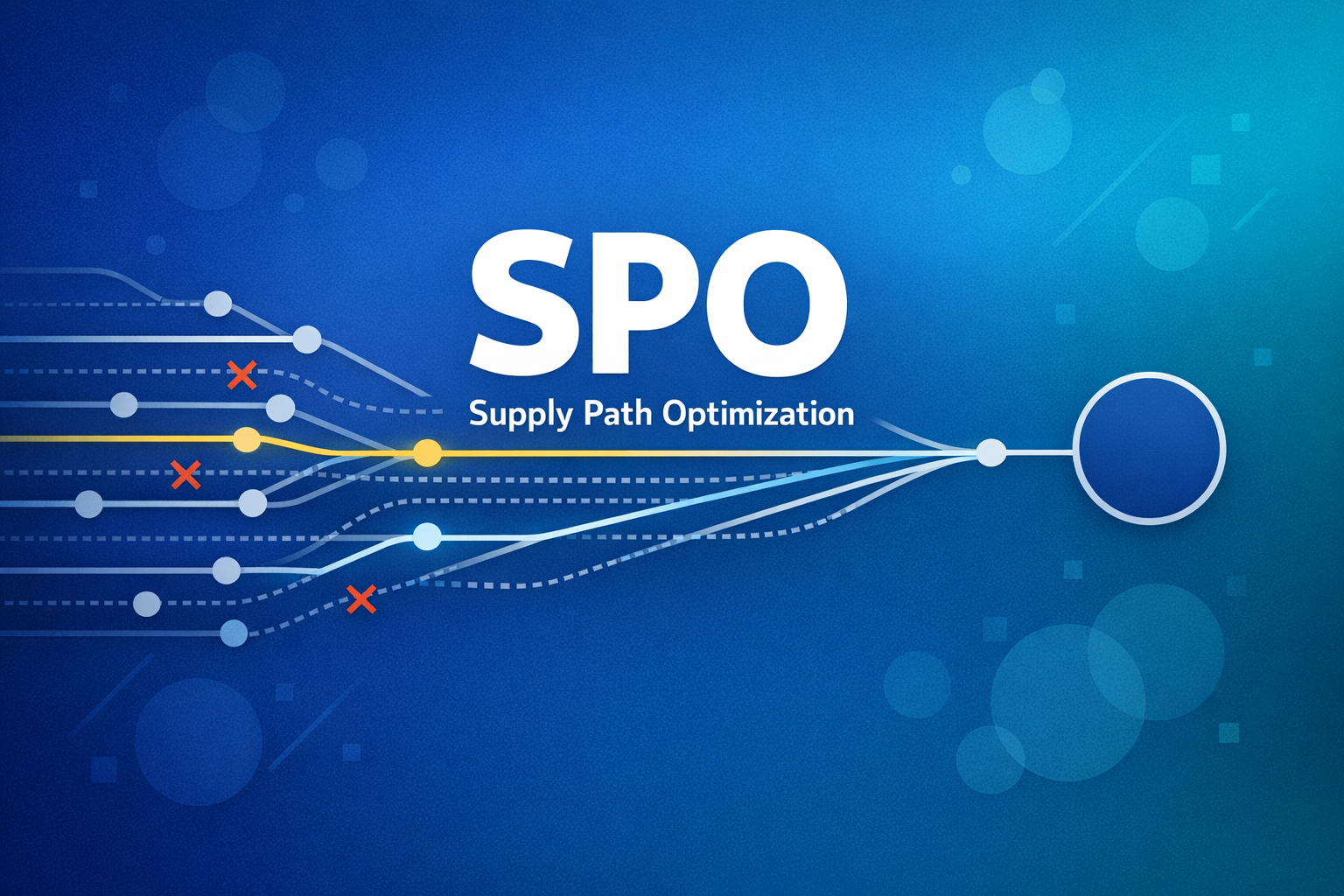
If you work in ad monetization, you have probably heard the term “supply path optimization” or SPO. It sounds like a straightforward efficiency improvement, but in practice it has added a significant layer of complexity to programmatic advertising, one that directly affects how much revenue publishers earn.
This guide explains what SPO is, why it emerged, how DSPs and SSPs are approaching it differently, and why publishers need informed partners to navigate it effectively.
Table of Contents
- What Is Supply Path Optimization?
- The Auction Duplication Problem
- How DSPs Respond: Throttling and Path Selection
- How SSPs Respond: Traffic Shaping and Prioritization
- No Single Approach: A Fragmented Landscape
- What This Means for Publishers
- Navigating SPO Complexity
- Frequently Asked Questions
What Is Supply Path Optimization?
Supply path optimization (SPO) is an umbrella term for the strategies that DSPs, SSPs, and advertisers use to reduce inefficiency in the programmatic supply chain. The core idea is simple: when multiple paths exist between an advertiser and a publisher’s inventory, choose the one that delivers the best combination of cost, speed, and quality.
In theory, SPO should benefit everyone: advertisers pay less in intermediary fees, publishers retain more of the clearing price, and the overall ecosystem becomes more efficient. According to the ANA’s 2024 Programmatic Benchmark Study, for every $1,000 entering a DSP, only $439 reaches the end consumer as working media, up from $360 in 2023. SPO is a major driver behind that improvement.
In practice, however, SPO is far from simple. Different DSPs and SSPs implement it in different ways, with different priorities and different consequences for publishers. Understanding these differences is essential for protecting and growing your ad revenue.
The Auction Duplication Problem
SPO emerged as a response to a specific technical problem: auction duplication.
When a publisher works with multiple SSPs, each SSP sends bid requests for the same impression to the same pool of DSPs. A single ad impression on your page might be offered to the same DSP five, ten, or even more times through different SSPs. The DSP receives all of these requests and must process them, but it is effectively the same opportunity presented repeatedly.
This duplication exploded as the programmatic ecosystem grew. Research from Jounce Media found that rebroadcasting supply chains account for 37% of display auctions and 32% of video auctions. Bidstream volume between DSPs and SSPs increased 2.3x between 2020 and 2023, far outpacing actual growth in available inventory.
The result is a massive volume of queries per second (QPS) that DSPs must process, the vast majority of which are duplicates. Processing bid requests costs money: server infrastructure, bandwidth, and computational resources. At a certain point, DSPs simply cannot, or choose not to, process all incoming requests at the same level of attention. Something has to give.
How DSPs Respond: Throttling and Path Selection
Faced with unsustainable QPS volumes, DSPs began implementing SPO algorithms to decide which supply paths to prioritize and which to throttle or disconnect entirely.
When a DSP receives the same impression through multiple SSPs, it evaluates each path based on factors like fee structure, historical win rates, auction timeout behavior, traffic quality signals, and the overall profitability of buying through that path. The DSP then selects its preferred path and reduces or eliminates bidding through the others.
This is not a gentle optimization. DSPs may fully disconnect from SSPs that consistently offer low-value paths, or they may throttle, processing only a fraction of bid requests from certain SSPs while giving full attention to preferred partners. The effect for publishers is that inventory routed through a deprioritized SSP path may receive fewer bids, lower CPMs, or no demand at all, even if the underlying inventory is identical.
Different DSPs approach this differently. The Trade Desk, for example, launched OpenPath, which enables direct bidding on publisher inventory via a Prebid adapter, reducing reliance on SSPs. The New York Post reported a 97% increase in programmatic display revenue and 8.6x higher fill rates after implementing it. Google’s DV360 takes a different approach, enforcing strict SupplyChain Object validation and blocking unauthorized paths. Other DSPs use proprietary scoring algorithms that weigh different signals with different priorities.
How SSPs Respond: Traffic Shaping and Prioritization
SSPs are not passive participants in this process. As DSPs throttle or disconnect less profitable paths, SSPs have responded with their own optimization strategies to protect their relationships with DSPs and stay on the “preferred path.”
The most common SSP response is traffic shaping: instead of forwarding every bid request from every publisher to every DSP, SSPs selectively filter which requests they send based on predicted value. An SSP might decide that certain types of inventory, certain geographies, or certain traffic patterns are unlikely to attract competitive bids from a particular DSP, and simply not send those requests. This reduces the QPS burden on the DSP and improves the SSP’s overall performance metrics, making it more likely to stay on the DSP’s preferred path list.
The consequence for publishers is subtle but significant. Your SSP partner may not be sending all of your bid requests to all available DSPs. Some impressions that could have attracted competitive bids may be filtered out before they ever reach a buyer. This is not necessarily harmful; well-executed traffic shaping can maintain revenue while reducing waste. But it means that the SSP is making optimization decisions on your behalf, and those decisions may not always align perfectly with your interests.
Some SSPs have gone further. Magnite launched ClearLine, a platform that gives agencies direct access to premium video inventory through Magnite’s ad server, effectively cutting out DSPs for certain deal types. This is SPO in reverse: instead of DSPs optimizing their supply paths, the SSP is optimizing its demand paths.
No Single Approach: A Fragmented Landscape
One of the most important things publishers need to understand about SPO is that there is no single, standardized approach. Every major DSP and SSP implements SPO differently, with different algorithms, different priorities, and different consequences.
- The Trade Desk prioritizes direct publisher integrations through OpenPath and, as of early 2026, OpenAds, its next-generation auction platform with commitments from publishers including AccuWeather, BuzzFeed, the Guardian, and Hearst.
- Google (DV360) enforces strict authorization checks via ads.txt and SupplyChain Object validation, and Google Ad Exchange ranked #1 in web SPO across the US, Canada, and all major EMEA and APAC regions in Pixalate’s Q4 2024 rankings.
- Amazon DSP uses its Dynamic Traffic Engine for collaborative traffic shaping with SSPs.
- Magnite takes an SSP-side approach with ClearLine, bypassing DSPs for certain premium video deals.
- GroupM built its Premium Marketplace as an agency-curated platform, controlling the entire path through partnerships with Magnite and PubMatic.
Meanwhile, the IAB Tech Lab continues to develop the technical standards underpinning SPO, including ads.txt, sellers.json, and the SupplyChain Object. In December 2024, the IAB Tech Lab formed a Curation Framework Working Group to formalize curation standards, but these frameworks are guidelines, not rules, and each platform interprets them in its own way.
This fragmentation means that what works well with one DSP may not work with another. An SSP that is on The Trade Desk’s preferred path list may be deprioritized by a different DSP. A supply chain configuration that maximizes Google AdX revenue may not be optimal for Amazon or Xandr demand. There is no single “clean supply path” that satisfies all buyers simultaneously.
What This Means for Publishers
SPO has real revenue consequences. When it works in your favor, it means more efficient auctions, higher fill rates, and better CPMs. When it works against you, it means your inventory is quietly deprioritized: fewer bids, lower clearing prices, and demand leaking to competitors whose supply paths are better optimized for specific buyers.
The challenge is that SPO is not something publishers can solve with a simple checklist. Oversimplified advice like “cut your SSP count” or “remove reseller lines from ads.txt” misses the reality of how modern programmatic works. Removing an SSP that appears to add little value on the surface might eliminate a path that a specific DSP with high-value demand prefers. The answer is not fewer SSPs or fewer ads.txt lines; it is the right SSPs and the right configuration for each demand source.
This requires knowing how major DSPs and SSPs are currently implementing SPO, which paths they prefer, what signals they prioritize, and how their strategies are evolving. It requires monitoring at the level of individual SSP-DSP path combinations and understanding which configurations maximize revenue across the full spectrum of demand, not just one buyer.
Navigating SPO Complexity
SPO has added a layer of complexity to programmatic advertising that most publishers are not equipped to navigate on their own. The strategies that DSPs and SSPs use are proprietary, they change frequently, and optimizing for one buyer can conflict with optimizing for another. What a publisher needs is not a simplified rule of thumb, but an informed partner with deep visibility into how the programmatic supply chain is actually functioning.
This is where Clickio’s expertise becomes a meaningful advantage. As a Google Certified Publishing Partner with direct relationships across major SSPs and DSPs, Clickio has real-time visibility into how supply paths perform across the ecosystem. Clickio’s Dynamic Demand Stack uses AI to select the top-performing demand partners for each impression, continuously adapting to the evolving preferences of DSPs and SSPs. Combined with header bidding via Prebid, Google Open Bidding, server-to-server integrations, and automatic price floor optimization, Clickio ensures that your inventory is presented through the paths that maximize revenue, not just the ones that look cleanest on paper.
Rather than following generic SPO advice, publishers working with Clickio benefit from a monetization strategy informed by actual market data: which DSPs are throttling which SSPs, which paths deliver the highest CPMs for specific traffic segments, and how to configure demand partnerships to capture value across the entire buyer landscape.
Frequently Asked Questions
What does SPO stand for in advertising?
SPO stands for Supply Path Optimization. It refers to the strategies DSPs, SSPs, and advertisers use to reduce inefficiency in the programmatic supply chain by selecting the most effective paths between buyers and publishers.
How does SPO affect publisher revenue?
SPO affects publisher revenue in both directions. When your inventory is on a preferred supply path, you benefit from more bids and higher CPMs. When a DSP throttles or disconnects the paths your inventory is offered through, you see fewer bids and lower revenue, even if the underlying inventory quality is the same.
What is the difference between SPO and DPO?
SPO (Supply Path Optimization) is buyer-driven: DSPs optimize which supply paths they buy through. DPO (Demand Path Optimization) is the publisher-side equivalent: publishers and their partners analyze and optimize the demand sources and paths through which their inventory is sold. The two are complementary.
Can publishers manage SPO on their own?
In theory, yes, but it is very difficult in practice. SPO involves navigating the proprietary and constantly evolving strategies of multiple DSPs and SSPs simultaneously. What works for one demand source may not work for another. Most publishers benefit from working with a monetization partner that has deep visibility into the programmatic ecosystem and can optimize supply paths across the full spectrum of demand.