
What Is a DSP? Demand-Side Platforms Explained for Publishers
Every ad impression on your website is bought by an advertiser using software. That software is a demand-side platform, or DSP. While publishers never use DSPs directly, these platforms determine how much advertisers bid on your inventory, which ads appear on your pages, and ultimately how much revenue you earn.
Understanding how DSPs work gives publishers a practical advantage: it explains why some impressions earn high CPMs while others sell for pennies, and what you can do to attract more competitive bids. This guide covers what a DSP is, how the bidding process works, the major DSP platforms, how DSPs differ from SSPs and ad networks, and what publishers can do to maximize DSP demand for their inventory.
Table of Contents
- What Is a DSP?
- How Does a DSP Work?
- What DSPs Evaluate When Bidding on Your Inventory
- Key Features of DSP Platforms
- Top DSP Platforms
- DSP vs SSP: What Is the Difference?
- DSP vs Ad Network: What Is the Difference?
- Why DSPs Matter for Publishers
- How DSPs Fit Into the Programmatic Ecosystem
- DSP Trends Shaping Publisher Revenue in 2026
- How to Maximize DSP Demand for Your Inventory
- Frequently Asked Questions
What Is a DSP?
A demand-side platform (DSP) is software that allows advertisers and agencies to purchase digital ad impressions across thousands of websites, apps, and streaming services through a single interface. The “demand side” refers to the buy side of advertising – the advertisers who have budget and want to reach audiences.
Before DSPs existed, advertisers bought ad space through direct deals with publishers or through ad networks that bundled inventory into predefined packages. This was slow, limited in scale, and gave advertisers little control over which specific users saw their ads. DSPs changed this by introducing automated, real-time purchasing. Instead of buying a block of 100,000 impressions on a website, an advertiser can now evaluate and bid on each impression individually – deciding in milliseconds whether a specific user on a specific page is worth showing their ad to.
Today, programmatic advertising accounts for over 90% of all digital display ad spending, and DSPs are the primary engine behind that volume.
How Does a DSP Work?
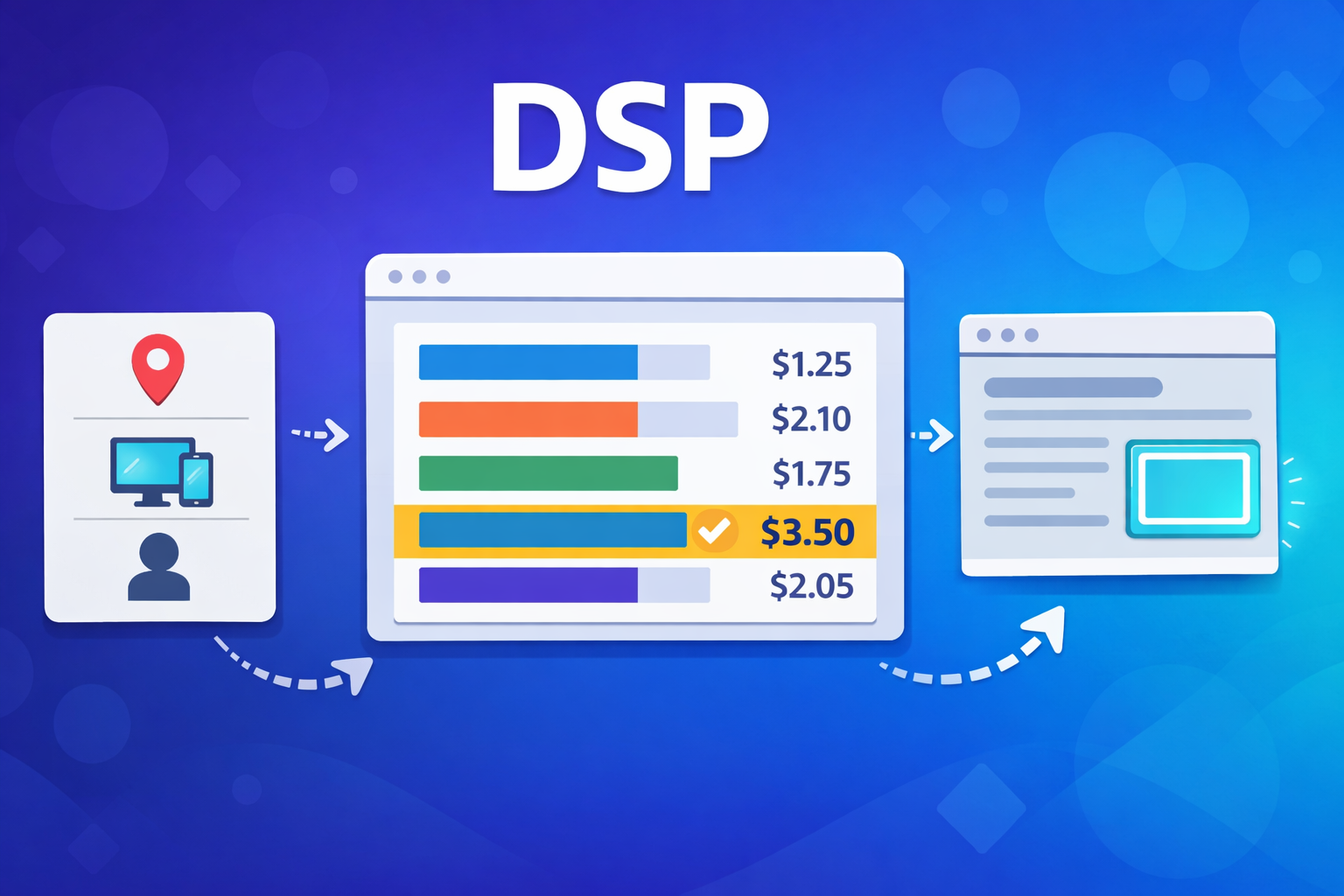
When a user loads a webpage with ad slots, the following process unfolds in roughly 100 milliseconds:
- User visits a publisher’s page – The page begins loading and the publisher’s ad server (such as Google Ad Manager) initiates an ad request.
- Bid request is broadcast – The publisher’s SSP sends a bid request to connected ad exchanges. This request includes information about the ad slot (size, position, page URL), the publisher’s price floor, and – if the user has given consent – anonymized data about the user (location, device, browsing context).
- DSPs evaluate the impression – Each connected DSP receives the bid request and runs it against active advertiser campaigns. The DSP checks: Does this user match the advertiser’s target audience? Is the page content brand-safe? What is the viewability probability for this ad slot? What has similar inventory historically performed at?
- DSPs submit bids – Within 50-100 milliseconds, each DSP responds with a bid price (or passes if the impression does not match any campaign criteria).
- Auction clears – The ad exchange collects bids and selects the winner. The winning DSP’s ad creative is sent to the user’s browser and displayed.
- Data is recorded – The DSP logs the impression. If the user later clicks, converts, or makes a purchase, that attribution data feeds back into the DSP’s algorithms to improve future bidding decisions.
This process repeats for every ad slot on every page, for every user who visits your site. A single page with five ad slots generates five separate auctions, each with potentially different winning bidders and prices.
What DSPs Evaluate When Bidding on Your Inventory
DSPs do not bid blindly. Their algorithms evaluate each impression against multiple criteria before deciding whether to bid and at what price. Understanding these criteria helps publishers optimize their sites to attract higher bids.
- Audience match – Does the user fit the advertiser’s target demographic, interest, or behavioral segment? Users who match high-value audience segments (such as in-market shoppers or business decision-makers) attract higher bids.
- Viewability – Is the ad slot likely to actually be seen by the user? DSPs track viewability rates by publisher and ad placement. Slots with high viewability scores attract more bids and higher CPMs.
- Brand safety – Is the page content safe for the advertiser’s brand? DSPs use verification tools (IAS, DoubleVerify) to classify page content. Pages flagged for unsafe content receive fewer bids.
- Ad fraud signals – Is the traffic legitimate? DSPs check for bot traffic, invalid clicks, and other fraud indicators. Publishers with clean traffic profiles and proper ads.txt implementation receive more trust and more bids.
- Historical performance – How have ads performed on this publisher’s site in the past? DSPs track metrics like click-through rates, conversion rates, and viewability across publishers. Sites with strong performance history attract premium demand.
- Price floor – What is the publisher’s minimum acceptable bid? DSPs weigh floor prices against expected campaign value. Floors that are too high cause DSPs to pass; floors that are too low leave revenue on the table.
Key Features of DSP Platforms
Modern DSPs are sophisticated platforms with capabilities that go far beyond simple ad buying. Here are the core features that shape how advertisers purchase your inventory.
Targeting Capabilities
DSPs give advertisers granular control over who sees their ads. Targeting options include demographics, geographic location (down to zip code level), device type, contextual relevance (based on page content), behavioral segments, retargeting (re-engaging previous site visitors), and first-party data audiences uploaded from the advertiser’s own CRM.
Deal Types
DSPs support multiple transaction models, each offering different trade-offs between price, access, and volume:
- Open auction (RTB) – Any advertiser can bid on any available impression. Widest reach but lowest CPMs.
- Private marketplace (PMP) – Invitation-only auction where publishers offer inventory to select advertisers at higher floor prices. Typically delivers 2-5x higher CPMs than open auction.
- Preferred deals – Fixed-price agreement where a specific advertiser gets first look at inventory before it goes to auction. If the advertiser passes, the impression falls to open auction.
- Programmatic guaranteed – Pre-negotiated fixed price and guaranteed impression volume, executed programmatically. Most predictable revenue stream, closest to a traditional direct deal.
For publishers, these deal types represent a revenue hierarchy: programmatic guaranteed and preferred deals typically pay the highest CPMs, followed by PMP, then open auction. Working with a monetization partner that facilitates PMP and programmatic guaranteed deals can significantly increase your average CPMs.
Supply Path Optimization (SPO)
This is an increasingly important DSP feature that directly affects publishers. DSPs analyze all available paths to reach a publisher’s inventory and prefer the shortest, most transparent, lowest-fee route. If your inventory is accessible through multiple redundant intermediaries (each taking a fee), DSPs may prefer a competitor’s inventory that has a cleaner, more direct supply path.
For publishers, this means working with SSPs and monetization partners that maintain direct, trusted relationships with major DSPs.
Top DSP Platforms
The DSP market includes a range of platforms with different strengths. Here are some of the most prominent DSPs that publishers are likely to encounter as sources of demand for their inventory.
| DSP Platform | Key Strengths |
|---|---|
| Google DV360 | Largest DSP by spending volume; deep integration with YouTube and Google’s audience data; dominant source of demand for most publishers |
| The Trade Desk | Leading independent DSP; built for the open internet; strong in CTV and audio; leads Unified ID 2.0 (UID2) adoption for cookieless targeting |
| Amazon DSP | Unique access to Amazon’s first-party shopper data; strong for retail and CPG advertisers; growing CTV presence via Prime Video |
| StackAdapt | Fast-growing independent DSP; strong in native, display, video, and CTV; popular with mid-market advertisers and agencies |
| Yahoo DSP | Leverages Yahoo’s first-party data from Yahoo Mail, Finance, and Sports; strong in news and finance verticals |
| Adobe Advertising | Enterprise-grade DSP integrated with Adobe Experience Cloud; used by large brands with existing Adobe investments |
Google DV360, The Trade Desk, and Amazon DSP are widely considered the three largest DSPs by spending volume. However, independent and specialized DSPs collectively represent significant buying power, and the landscape continues to evolve. Publishers who connect to multiple demand sources through header bidding maximize their exposure to demand from all major DSPs.
DSP vs SSP: What Is the Difference?
DSPs and SSPs are mirror images of each other in the programmatic advertising ecosystem. The DSP serves the buyer; the SSP serves the seller.
| Dimension | DSP (Demand-Side Platform) | SSP (Supply-Side Platform) |
|---|---|---|
| Who uses it | Advertisers and agencies | Publishers |
| Goal | Buy the right impressions at the best price | Sell inventory at the highest possible yield |
| Money flow | Budget flows out (spending) | Revenue flows in (earning) |
| Key optimization | CPC, CPA, ROAS, viewability | eCPM, fill rate, revenue per session |
| Data focus | Audience targeting and campaign performance | Yield optimization, floor pricing, demand partner management |
| Examples | Google DV360, The Trade Desk, Amazon DSP | Google Ad Manager, Magnite, PubMatic, Index Exchange |
Here is how they interact: when a publisher’s page loads, the SSP packages the available impression and sends a bid request to the ad exchange. The ad exchange broadcasts this opportunity to connected DSPs. The DSPs evaluate the impression and submit bids. The SSP collects the winning bid, and the publisher receives payment (minus SSP and exchange fees).
The critical insight for publishers is that more DSPs competing for your inventory means higher CPMs. This is exactly why header bidding works – it connects publishers to multiple SSPs simultaneously, which in turn exposes each impression to a wider pool of DSPs. More competition equals higher revenue.
DSP vs Ad Network: What Is the Difference?
While DSPs have largely replaced traditional ad networks for programmatic buying, it helps to understand how they differ.
| Dimension | DSP | Ad Network |
|---|---|---|
| Pricing | Real-time bidding; dynamic CPM based on actual impression value | Fixed or negotiated CPM rates |
| Transparency | Full visibility into which sites and users are targeted | Often opaque about publisher partners and final pricing |
| Inventory access | Thousands of publishers via exchanges simultaneously | Pre-bundled packages from the network’s publisher pool |
| Targeting | Fully customizable; advertisers can upload their own data | Pre-defined segments with limited customization |
| Technology | Fully automated, auction-based, algorithmic | Often manual or semi-automated |
For publishers, the practical difference is this: ad networks offered guaranteed fill at set CPMs, while DSPs offer variable but potentially much higher CPMs through open competition. The shift from ad networks to DSP-driven programmatic buying is a major reason why header bidding and multi-exchange setups have become standard practice for revenue optimization. For a deeper look at ad network options, see our guide on best ad networks for publishers.
Why DSPs Matter for Publishers
Publishers do not use DSPs directly – you use SSPs and ad servers. But DSPs are the technology that determines the value of every programmatic impression you sell. Here is why understanding the DSP side of the equation matters for your revenue.
DSP Algorithms Grade Your Inventory
Every DSP builds a quality score for each publisher it transacts with. This score is based on viewability rates, brand safety profile, audience quality, historical conversion performance, and traffic legitimacy. Publishers that score well attract more DSP bids and higher bid prices. Publishers that score poorly get passed over in favor of better-rated inventory.
This means that technical improvements to your site – better ad placement for viewability, faster page loads that improve Core Web Vitals, clean traffic sources, and proper brand safety content – directly translate into higher DSP bids and better CPMs.
Floor Prices Interact Directly with DSP Bidding
Publishers set minimum acceptable prices (floor prices) through their SSPs. DSPs see these floors and decide whether to bid above them. Set floors too high and DSPs pass, dropping your fill rate. Set floors too low and you leave money on the table. Effective floor price optimization requires understanding how DSPs value your inventory across different segments (geography, device, time of day, content category).
Premium Deal Types Unlock Higher Revenue
Beyond the open auction, publishers can work with DSP buyers to set up private marketplace deals, preferred deals, and programmatic guaranteed arrangements. These deal types consistently deliver higher CPMs than open exchange because the advertiser is paying for exclusivity, guaranteed placement, or premium audience access. Publishers who work with monetization partners that facilitate these deal types benefit from revenue that is not available through open auction alone.
Identity Solutions Attract More DSP Demand
With third-party cookies becoming less reliable, DSPs have shifted to alternative identity solutions like Unified ID 2.0 (UID2), RampID, and ID5 for audience targeting. Publishers who implement these identity solutions on their sites give DSPs better targeting capabilities, which translates into more bids and higher CPMs. Publishers without identity solutions may see reduced demand as DSPs prioritize inventory where they can accurately target users.
How DSPs Fit Into the Programmatic Ecosystem
The programmatic advertising stack has several layers, and the DSP sits on the buy side. Here is how all the pieces connect:
- Advertiser – Has budget and campaign goals (awareness, conversions, app installs)
- DSP – Executes the advertiser’s buying strategy across exchanges and SSPs
- Ad exchange – The auction marketplace where impressions are traded
- SSP – The publisher’s tool for managing inventory, setting floors, and connecting to exchanges
- Ad server – Manages the publisher’s ad slots, decides which demand source wins each impression (e.g., Google Ad Manager)
- Publisher – Owns the website and the ad inventory
DSP buyers also allocate budget in a priority hierarchy: programmatic guaranteed commitments are funded first, then preferred deals, then PMP, and finally open auction. This means that during periods of high advertiser spending (such as Q4 holiday season), more budget flows into guaranteed and preferred deals, which can actually reduce open auction CPMs. Publishers who participate in direct deals capture revenue at the top of this hierarchy rather than competing solely in the open auction.
DSP Trends Shaping Publisher Revenue in 2026
The DSP landscape is evolving rapidly, and several trends have direct implications for publishers.
AI-Driven Campaign Optimization
DSPs are moving beyond basic algorithmic bidding to fully AI-driven campaign management. Platforms like The Trade Desk’s Kokai and Google’s Performance Max autonomously adjust bids, shift budgets, and refresh audience segments in real time. For publishers, this means DSP bidding decisions are becoming faster, more data-driven, and harder to predict. Sites with strong, consistent performance signals will be rewarded more aggressively by AI-optimized campaigns.
Cookieless Identity and First-Party Data
The deprecation of third-party cookies is reshaping how DSPs target users. The industry is moving toward alternative identity solutions (UID2, RampID, ID5), data clean rooms for privacy-safe matching, and a resurgence of contextual targeting. Publishers who build first-party data strategies and implement identity solutions will see more DSP demand for their inventory compared to those who rely solely on third-party cookies.
Supply Path Optimization (SPO) Maturity
DSPs are increasingly cutting redundant supply paths to reduce fees and improve auction transparency. This means publishers who are accessible through preferred, direct SSP relationships will capture more budget. Working with well-connected monetization partners that maintain trusted relationships with major DSPs is more important than ever.
CTV and Video Growth
Connected TV (CTV) ad spending continues to grow rapidly, with over 84% of US CTV ad spending now transacting programmatically through DSPs. While this primarily benefits video and streaming publishers, the broader trend toward video advertising means that publishers with video content can command significantly higher CPMs from DSP buyers.
How to Maximize DSP Demand for Your Inventory
While publishers cannot control DSP bidding directly, there are concrete steps you can take to make your inventory more attractive to DSP buyers.
- Optimize ad viewability – Place ads where users actually see them. Sticky formats, in-content placements, and lazy-loaded ads all improve viewability scores, which DSPs use to evaluate your inventory.
- Connect to multiple demand sources – Use header bidding to expose your inventory to the widest possible pool of DSPs. More competition means higher clearing prices.
- Maintain clean traffic – Bot traffic and invalid clicks destroy your reputation with DSP algorithms. Monitor traffic sources and implement fraud prevention measures.
- Implement identity solutions – Support UID2, ID5, or other alternative IDs to help DSPs target users accurately on your site, which increases bid values.
- Optimize price floors – Use dynamic floor pricing that adjusts by geography, device, and time of day. Static floors leave money on the table or drive away demand.
- Improve page speed – Fast-loading pages with strong Core Web Vitals scores signal quality to DSPs and reduce ad latency, improving both viewability and user experience.
- Ensure brand safety – Keep your content clearly categorized and avoid hosting user-generated content without moderation. Brand-safe inventory attracts premium advertiser budgets.
- Maintain proper ads.txt – An accurate, up-to-date ads.txt file tells DSPs that your inventory is legitimate and authorized for sale, building trust with buyers.
How Clickio Helps Publishers Attract Premium DSP Demand
Clickio is a Google Certified Publishing Partner that optimizes every aspect of how your inventory is presented to DSP buyers.
- 20+ demand partners competing – Clickio’s Dynamic Demand Stack connects publishers to Xandr, Magnite, OpenX, PubMatic, Index Exchange, Criteo, and more. Every major DSP has a path to your inventory, maximizing bidding competition.
- Google AdX via MCM – Clickio provides access to Google Ad Exchange through Google’s Multiple Customer Management program, connecting your inventory to Google DV360 – the largest DSP by market share.
- Header bidding + Open Bidding + S2S – Clickio combines multiple auction types (Prebid header bidding, Google Open Bidding, and server-to-server bidding) to expose each impression to the maximum number of DSP buyers while keeping page latency low.
- AI-powered price floor optimization – Clickio dynamically adjusts price floors per country, device, format, and user engagement level. This ensures DSPs pay the true value of each impression without driving them away with static, one-size-fits-all floors.
- Viewability-optimized ad formats – Sticky ads, smart in-article placements, lazy loading, and smart ad refresh all maximize the viewability metrics that DSPs use to score your inventory.
- AdSense Mediation – Keep your existing AdSense account competing alongside premium DSP demand – with zero commission on AdSense earnings.
Frequently Asked Questions
What is a DSP in simple terms?
A DSP (demand-side platform) is the software advertisers use to buy ad space on websites and apps through automated, real-time auctions. It is the buy side of programmatic advertising – the technology that decides which ads appear on your site and how much advertisers pay for each impression.
What is the difference between a DSP and an SSP?
A DSP is used by advertisers to buy ad impressions, while an SSP is used by publishers to sell ad inventory. They work together through ad exchanges: the SSP sends available impressions to the exchange, DSPs bid on them, and the highest bidder wins. Publishers use SSPs; advertisers use DSPs.
Do publishers need to use a DSP?
No. DSPs are buyer-side tools used by advertisers and agencies. Publishers use SSPs and ad servers (like Google Ad Manager) to sell their inventory. However, understanding how DSPs work helps publishers optimize their setup to attract more competitive bids and earn higher CPMs.
What is the biggest DSP?
Google Display & Video 360 (DV360) is widely considered the largest DSP by spending volume. The Trade Desk and Amazon DSP are the other two major platforms. Together, these three DSPs represent the majority of programmatic ad buying, though the exact market share breakdown varies by data source and region.
How do DSPs affect my ad revenue?
DSPs determine how much advertisers bid on your inventory. When more DSPs compete for your impressions, prices go up. Your ad revenue is directly influenced by how many DSPs can access your inventory (through header bidding and SSP connections), how DSP algorithms rate your site quality (viewability, brand safety, traffic legitimacy), and whether you participate in premium deal types (PMPs, preferred deals) that attract higher DSP bids.
Conclusion
Demand-side platforms are the engines that power programmatic advertising. While publishers never use DSPs directly, these platforms determine the value of every impression you sell. The more you understand about how DSPs evaluate and bid on inventory, the better positioned you are to optimize your setup and maximize revenue.
The key takeaways for publishers: DSP competition drives your CPMs, so connect to as many demand sources as possible through header bidding. Your site quality (viewability, speed, brand safety, traffic legitimacy) directly affects how DSPs value your inventory. And premium deal types like PMPs and programmatic guaranteed can unlock significantly higher CPMs than the open auction alone.
If you want to maximize DSP demand for your inventory without managing the technical complexity yourself, Clickio can help. As a Google Certified Publishing Partner, Clickio connects your site to 20+ premium demand partners and uses AI-powered optimization to ensure every impression earns its maximum value.