
What Is Header Bidding? A Publisher’s Guide for 2026
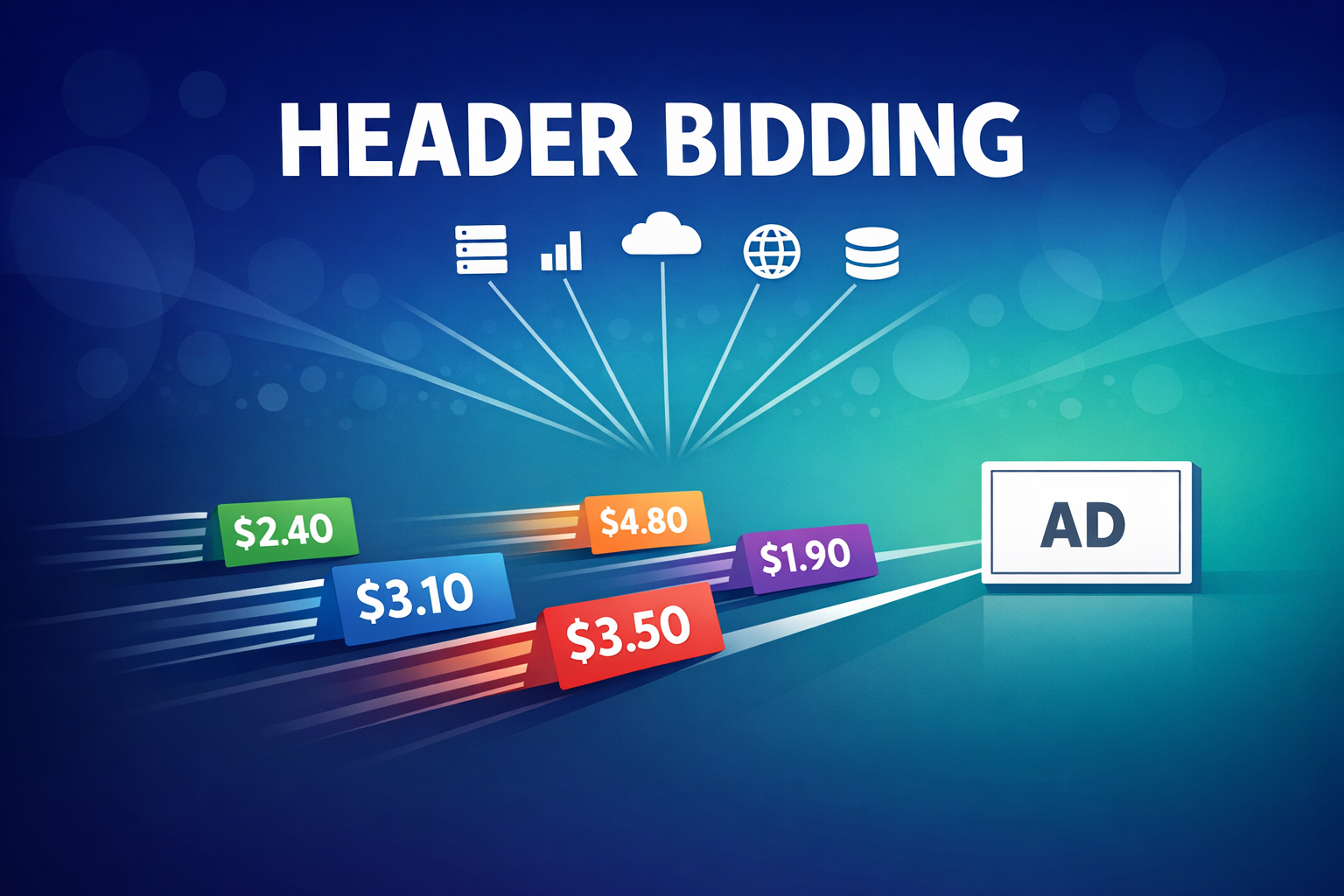
Header bidding is the single most impactful technology change for publisher ad revenue in the last decade. Before header bidding, publishers relied on a sequential “waterfall” system that left money on the table with every impression. Header bidding replaced that with a simultaneous auction where every demand source competes at the same time, and the highest bidder wins.
The result: publishers who implement header bidding typically see CPM increases of 20-40% compared to waterfall setups. This guide explains how header bidding works, the difference between client-side and server-side approaches, the key technologies involved, and how publishers can get the most out of it in 2026.
Table of Contents
- What Is Header Bidding?
- The Waterfall Problem and How Header Bidding Solved It
- How Header Bidding Works: Step by Step
- Client-Side vs Server-Side Header Bidding
- Key Technologies: Prebid.js and Google Open Bidding
- Benefits of Header Bidding for Publishers
- Implementation: Build vs Buy
- Common Challenges and How to Solve Them
- Header Bidding Trends in 2026
- How Clickio Implements Header Bidding for Publishers
- Frequently Asked Questions
- Conclusion
What Is Header Bidding?
Header bidding is a programmatic advertising technique that lets publishers offer their ad inventory to multiple ad exchanges and demand sources simultaneously, before their ad server makes a final decision on which ad to show. The term comes from the JavaScript code originally placed in the <head> section of a webpage, though modern implementations are more flexible.
In practical terms, header bidding creates a fair, competitive auction for every single ad impression on your site. Instead of giving one demand partner the first chance to bid (and settling for whatever they offer), you let everyone bid at once and take the highest price. It is the foundation of how modern publisher monetization works within the broader programmatic advertising ecosystem.
The Waterfall Problem and How Header Bidding Solved It
To understand why header bidding matters, you need to understand the system it largely replaced: the waterfall model.
How the Waterfall Worked
In the waterfall (also called a “daisy chain”), ad requests cascaded through demand partners one at a time, in a fixed order. The publisher ranked partners by their historical average CPM, and each partner got first look at the impression in sequence. The first partner willing to buy it won – even if a lower-ranked partner would have paid significantly more.
This created several problems:
- Lost revenue – A partner ranked #3 might have bid $5 for a specific impression, but the impression was already sold to partner #1 for $2 because they had a higher historical average
- Stale data – Rankings were based on past performance, not real-time demand, so the priority order was always slightly wrong
- Latency – Sequential calls meant each partner added loading time, degrading user experience
- No competition – Demand partners had no incentive to bid high when they were already at the top of the waterfall
How Header Bidding Fixed It
Header bidding largely replaced the sequential waterfall with a simultaneous auction. (The waterfall model still persists in some contexts, particularly mobile app monetization and hybrid setups, but for web publishers it is effectively obsolete as a primary strategy.) Every demand source bids on the impression at the same time, and the highest bid wins. This simple change transformed publisher economics: more competition per impression means higher prices, and every bidder must offer their true value because they know they are competing against everyone else.
| Factor | Waterfall | Header Bidding |
|---|---|---|
| Auction type | Sequential (one at a time) | Simultaneous (all at once) |
| Winner determined by | Position in the chain | Highest real-time bid |
| Pricing basis | Historical averages | Real-time market value |
| Revenue impact | Leaves money on the table | Captures true impression value |
| Transparency | Limited visibility into bids | Full bid-level reporting |
| Latency | Cumulative (each partner adds delay) | Parallel (all partners bid within one timeout) |
By 2022, over 70% of digital publishers in the United States had adopted header bidding. Today, it is the standard approach to ad monetization for any publisher serious about maximizing revenue.
How Header Bidding Works: Step by Step
Here is what happens in the milliseconds between a user loading your page and seeing an ad:
- Page loads – A user visits your website. The header bidding wrapper (a JavaScript library like Prebid.js) begins executing.
- Bid requests fire – The wrapper sends bid requests to all configured demand partners (SSPs, ad exchanges, DSPs) simultaneously.
- Partners respond – Each demand partner evaluates the impression (user data, page context, ad size, device) and returns a bid. All of this happens within a timeout window, typically 1,000-1,500 milliseconds.
- Wrapper collects bids – The wrapper gathers all responses and identifies the highest bid for each ad slot.
- Ad server decides – The winning header bid is passed to the publisher’s ad server (usually Google Ad Manager) as a key-value pair. The ad server compares it against any direct-sold campaigns or its own exchange demand (such as Google AdX).
- Ad renders – The overall highest bid wins, and the ad is served to the user.
The entire process typically completes within 1-2 seconds, often finishing before the page fully loads.
Client-Side vs Server-Side Header Bidding
There are two fundamentally different ways to run the header bidding auction, and each comes with meaningful tradeoffs.
Client-Side Header Bidding
In client-side header bidding, the auction runs in the user’s browser. JavaScript code (typically Prebid.js) sends bid requests directly from the browser to demand partners and collects their responses.
Advantages:
- Maximum transparency – publishers see exactly which advertiser bid how much
- Better cookie matching – direct browser access enables more accurate user identification
- Lower infrastructure cost – no servers to maintain
- Full publisher control over partner configuration
Disadvantages:
- Adds page latency – each demand partner means another HTTP request from the browser
- Browser connection limits cap how many partners can participate effectively
- Vulnerable to ad blockers
- Adding too many partners creates diminishing returns as page speed drops
Server-Side Header Bidding
In server-side header bidding, the auction runs on a remote server. The browser makes a single request to the server, which then contacts all demand partners, collects bids, and returns the winner.
Advantages:
- Dramatically reduces page latency – only one request leaves the browser
- No browser connection limits, so more demand partners can participate
- Better for video and rich media (heavy creative payloads)
- Scales efficiently for high-traffic publishers
Disadvantages:
- Less transparency – publishers have reduced visibility into individual bids
- Limited cookie matching (no direct browser access) can reduce bid accuracy
- Requires server infrastructure, adding operational complexity and cost
The Hybrid Approach (Best Practice)
Most advanced monetization setups today run both client-side and server-side auctions concurrently. A handful of high-value partners bid client-side (where cookie matching gives them the data they need to bid aggressively), while additional partners bid server-side (keeping latency low). The best bid across both auctions wins.
This hybrid approach captures the strengths of both methods: the targeting accuracy and transparency of client-side, combined with the speed and scalability of server-side. It is the approach used by Clickio’s 360.js script, which runs Prebid, Open Bidding, and server-to-server auctions concurrently through a single integration.
Key Technologies: Prebid.js and Google Open Bidding
Two major technologies power header bidding for publishers today. Understanding each one helps you evaluate which approach fits your needs.
Prebid.js
Prebid.js is the most widely used header bidding wrapper in the world. It is free, open source, and maintained by Prebid.org. It supports both client-side (Prebid.js) and server-side (Prebid Server) implementations and works with hundreds of demand partner adapters.
Any publisher can download and configure Prebid.js regardless of traffic size. It offers granular control over timeout settings, partner priority, and analytics. In 2026, Prebid continues to evolve, with ongoing work on OpenRTB 2.6 support and expanded identity module support for environments where third-party cookies are restricted. Notably, Clickio is a registered Prebid.js bidder with its own adapter, meaning Clickio’s demand competes natively within the Prebid ecosystem.
Google Open Bidding
Google Open Bidding (formerly EBDA – Exchange Bidding in Dynamic Allocation) is Google’s server-side header bidding solution, built directly into Google Ad Manager. It is the simplest to implement for publishers already using GAM, since it requires no additional JavaScript on the page.
The tradeoff is transparency: Google takes a revenue share from participating SSPs, and publishers have less visibility into the bidding details compared to Prebid. However, the reduced latency and seamless GAM integration make it a practical complement to Prebid-based setups.
Important: These technologies are not mutually exclusive. Publishers can run Prebid and Google Open Bidding simultaneously, and the best bid across both auction systems wins. Managed solutions like Clickio take this further by combining Prebid, Open Bidding, and server-to-server bidding into a single unified auction, maximizing competition for every impression.
Benefits of Header Bidding for Publishers
The data on header bidding’s revenue impact is consistent across multiple sources:
- 20-40% CPM increase compared to waterfall setups is the typical range reported by publishers, with some early adopters reporting even higher gains
- Higher fill rates – More demand partners competing means more chances to sell every impression, even in low-demand geos or off-peak hours
- Pricing transparency – Publishers can see exactly what each demand source is willing to pay, enabling data-driven optimization decisions
- Reduced dependency on a single demand source – Without header bidding, many publishers relied almost entirely on Google AdX. Header bidding opened up genuine competition from dozens of other exchanges
- Fair competition – All bidders play by the same rules. No single demand source gets preferential “last look” access
- Better data for negotiation – Understanding what demand partners bid for your inventory strengthens your position when negotiating direct deals or PMP arrangements
Real-world examples reinforce these numbers. The Telegraph reported 70% higher programmatic revenues after implementing header bidding in 2016, during the early adoption wave. Criteo tested its Direct Bidder with 250 publishers and saw 20-40% higher revenue from Criteo’s own ad buys specifically, demonstrating how much more demand partners are willing to pay when they compete in a fair auction rather than through the waterfall.
Implementation: Build vs Buy
Publishers have two paths to implement header bidding: build it in-house or use a managed solution.
Self-Managed (Prebid.js DIY)
Publishers can download Prebid.js, configure demand partner adapters, set up line items in Google Ad Manager, and manage the entire stack themselves. This gives maximum control over every aspect of the setup.
However, it requires dedicated ad operations expertise to do well. Key decisions include:
- Timeout settings – Too low (under 1,000ms) and high-value partners cannot respond in time; too high (over 3,000ms) and page speed suffers. Most publishers start around 1,000-1,500ms and test from there.
- Number of demand partners – More is not always better. Each client-side partner adds latency. Adding a 6th or 7th partner often delivers less incremental revenue than it costs in page speed.
- Price floor management – Dynamic floors that adjust by geo, device, and time of day outperform static floors, but require ongoing data analysis.
- Line item setup – GAM requires hundreds of line items to properly pass header bidding bids. This is time-consuming to set up and maintain.
Managed Solutions
Managed header bidding providers handle the implementation, optimization, demand partner relationships, and ongoing tuning. The publisher adds a single script to their site, and the provider manages everything else in exchange for a revenue share.
This is the right choice for publishers who want the revenue benefits of header bidding without building an in-house ad ops team. The best managed solutions – such as Clickio – combine header bidding with other auction types (Open Bidding, server-to-server) and use AI-powered optimization to continuously improve results. Clickio, for example, connects publishers to 20+ premium demand partners and dynamically adjusts price floors per country, device, and format, all through a single script.
Common Challenges and How to Solve Them
| Challenge | Solution |
|---|---|
| Page latency from too many partners | Use a hybrid client/server approach, optimize timeouts, implement lazy loading for below-the-fold ads |
| Diminishing returns from adding partners | Audit partner performance regularly and remove underperformers; focus on quality over quantity |
| Reporting discrepancies | Implement Prebid analytics adapters and reconcile against ad server data monthly |
| Cookie restrictions reducing bid accuracy (Safari, Firefox) | Adopt first-party data strategies, contextual targeting, and Prebid’s identity modules (UID2, ID5) |
| Ad blocker interference (client-side) | Shift more demand to server-side, where ad blockers have less visibility |
| Complex line item management in GAM | Use a managed solution or automated line item creation tools |
Header Bidding Trends in 2026
Privacy-First Bidding
The third-party cookie landscape has fragmented. Safari blocks them entirely, Firefox partitions them by default, and while Chrome reversed its planned deprecation in 2024 and still supports them, the broader industry is moving toward privacy-first alternatives. Header bidding solutions are adapting with first-party data integration, contextual targeting, and alternative identity solutions (UID2, ID5). Publishers who invest in consent management and first-party data strategies are better positioned regardless of how cookie policies evolve further.
AI-Driven Yield Optimization
AI is being applied across the header bidding stack: dynamic timeout adjustment, intelligent floor pricing, partner selection per impression, and predictive bid analysis. Prebid.org has even open-sourced a “Sales Agent” built on AI that helps publishers automate programmatic deal management. The gap between well-optimized and poorly-optimized header bidding setups is widening, with industry practitioners estimating that tuned configurations can unlock 15-30% additional yield over default setups.
Video Header Bidding
Video advertising commands significantly higher CPMs than display, and header bidding for video is growing rapidly. Server-side implementations are preferred for video because of the large creative payload sizes. Publishers adding video content to their sites can capture this demand through video-capable header bidding setups.
Supply Path Optimization (SPO)
DSPs are increasingly cutting redundant supply paths to reduce fees and improve auction transparency. This is a form of supply path optimization. For publishers, it means working with well-connected monetization partners that maintain direct, trusted relationships with major DSPs is more important than ever. Being accessible through preferred supply paths means more demand and higher bids.
How Clickio Implements Header Bidding for Publishers
Clickio is a Google Certified Publishing Partner and a registered Prebid.js bidder that uses a unified header bidding approach to maximize publisher revenue.
- Single script, all auction types – Clickio’s 360.js integrates Prebid header bidding, Google Open Bidding, and server-to-server bidding into one lightweight script. This hybrid approach maximizes demand competition while keeping page latency minimal.
- 20+ premium demand partners – Xandr, Magnite, OpenX, PubMatic, Index Exchange, Criteo, Google AdX, and more. Every major demand source competes for your inventory on every impression.
- AI-powered price floors – Dynamic floor pricing adjusts per country, device, format, and engagement level, ensuring you capture the true value of each impression without driving away demand with static floors.
- Google AdX access via MCM – Clickio provides access to Google Ad Exchange through Google’s Multiple Customer Management program, adding the world’s largest exchange to your header bidding competition.
- AMP support – As an official AMP Ad Vendor, Clickio unlocks Prebid header bidding on AMP pages, a capability many other solutions cannot offer.
Frequently Asked Questions
What is header bidding in simple terms?
Header bidding is a way for publishers to let multiple ad buyers compete for their ad space at the same time. Instead of offering impressions to one buyer at a time (the old waterfall method), header bidding runs a simultaneous auction where every buyer bids at once. The highest bid wins, which means publishers earn more money per impression.
Does header bidding slow down my website?
Client-side header bidding adds some page latency because multiple bid requests are sent from the browser. However, this can be minimized with proper timeout settings (typically 1,000-1,500ms), lazy loading for below-the-fold ads, and hybrid client/server setups. A well-optimized header bidding implementation adds manageable load time while significantly increasing revenue.
How many demand partners should I use in header bidding?
For client-side header bidding, 5-6 partners is typically optimal. Beyond that, the additional latency often outweighs the incremental revenue. Server-side setups can accommodate more partners without latency penalties. A hybrid approach lets you run a focused client-side auction alongside a broader server-side one, capturing the best of both worlds.
What is the difference between header bidding and Google Open Bidding?
Header bidding (typically Prebid.js) runs its auction independently before passing winning bids to the ad server. Google Open Bidding is Google’s built-in server-side solution that runs within Google Ad Manager. Header bidding gives publishers more control and transparency; Open Bidding is simpler to implement but less transparent. Many publishers run both simultaneously.
Is Prebid.js free?
Yes. Prebid.js is free and open source, maintained by Prebid.org. Any publisher can download, configure, and use it at no cost. However, running Prebid effectively requires ad operations expertise for configuration, optimization, and ongoing management, which is why many publishers opt for managed solutions.
Do I need Google Ad Manager for header bidding?
While not technically required, Google Ad Manager is the industry-standard ad server for header bidding. Almost all header bidding implementations pass their winning bids to GAM, which makes the final decision by comparing header bids against direct-sold campaigns and Google AdX demand. If you are using only Google AdSense, header bidding requires a GAM setup.
Conclusion
Header bidding fundamentally changed how publishers sell ad inventory. By largely replacing the sequential waterfall with a simultaneous auction, it increased competition, transparency, and ultimately revenue. Publishers who implement header bidding well typically see CPM increases of 20-40% compared to waterfall-era setups.
The key decisions for publishers in 2026 are: client-side vs server-side vs hybrid (hybrid wins in most cases), how many demand partners to include (quality over quantity), and whether to build in-house with Prebid.js or use a managed solution. For most publishers, a managed approach delivers better results faster, since optimizing header bidding is an ongoing process that requires continuous tuning of timeouts, floors, and partner configurations.
If you want to implement header bidding without the operational complexity, Clickio can help. As a Google Certified Publishing Partner with a registered Prebid.js bidder adapter and 20+ premium demand partners, Clickio’s unified auction stack handles all the technical optimization so you can focus on creating content.